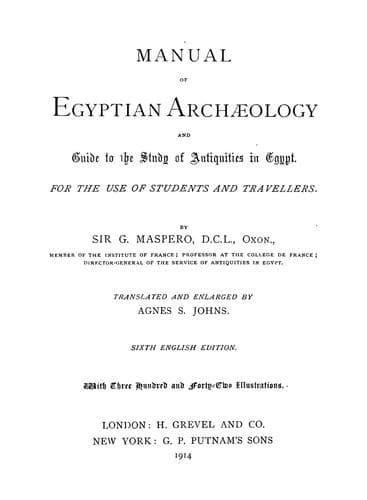
Manual of Egyptian Archaeology and Guide to the Study of Antiquities in EgyptMaspero, G. (Gaston)
History
Manual of Egyptian Archaeology and Guide to the Study of Antiquities in Egypt
Maspero, G. (Gaston)
Art -- Egypt; Egypt -- Antiquities
ventured upon no enterprises without consulting them. They stated their
difficulties, and the god replied to each question by a movement of the
head. According to the Stela of Bakhtan,[24] a statue of Khonsû places its
hands four times on the nape of the neck of another statue, so transmitting
the power of expelling demons. It was after a conversation with the statue
of Amen in the dusk of the sanctuary, that Queen Hatshepsût despatched her
squadron to the shores of the Land of Incense.[25] Theoretically, the
divine soul of the image was understood to be the only miracle worker;
practically, its speech and motion were the results of a pious fraud.
Interminable avenues of sphinxes, gigantic obelisks, massive pylons, halls
of a hundred columns, mysterious chambers of perpetual night--in a word,
the whole Egyptian temple and its dependencies--were built by way of a
hiding-place for a performing puppet, of which the wires were worked by a
priest.
[21] That is, the spirits of the North, represented by On (Heliopolis), and
of the South (Khonû).--A.B.E.
[22] At Tanis there seems to have been a close succession of obelisks and
statues along the main avenue leading to the Temple, without the usual
corresponding pylons. These were ranged in pairs; _i.e._, a pair
of obelisks, a pair of statues; a pair of obelisks, a pair of shrines;
and then a third pair of obelisks. See _Tanis_, Part I., by
W.M.F. Petrie, published by the Egypt Exploration Fund, 1884.--A.B.E.
[23] This fact is recorded in the hieroglyphic inscription upon the
obelisks.--A.B.E.
[24] This celebrated tablet, preserved in the Bibliothèque Nationale,
Paris, has been frequently translated, and is the subject of a
valuable treatise by the late Vicomte de Rougé. It was considered
authentic till Dr. Erman, in an admirable paper contributed to the
_Zeitschrift,_ 1883, showed it to have been a forgery concocted
by the priests of Khonsû during the period of the Persian rule in
Egypt, or in early Ptolemaic times. (See Maspero's _Hist. Ancienne
des Peuples de l'Orient_, chap, vi., pp. 287, 288. Fourth
Edition.)--A.B.E.
[25] The Land of Incense, called also in the inscriptions "The Land of
Pûnt," was the country from which the Egyptians imported spices,
precious woods, gums, etc. It is supposed to represent the southern
coasts of the Red Sea, on either side the Bab el Mandeb. Queen
Hatshepsût's famous expedition is represented in a series of coloured
bas-relief sculptures on the walls of her great temple at Deir el
Baharî, reproduced in Dr. Dümichen's work, _The Fleet of an Egyptian
Queen_, and in Mariette's _Deîr el Baharî_. For a full account
of this temple, its decoration, and the expedition of Hatshepsût, see
the _Deir el Baharî_ publications of the Egypt Exploration Fund.
CHAPTER III.
_TOMBS_.
Public-domain text, read in full here on John Shaqi.
Reviews
Reviews
No reviews yet
Be the first to share your thoughts on this work.
Elsewhere in the archive
Join the Discussion
Join the discussion
Sign in to leave a comment or review.
Sign InorCreate an account