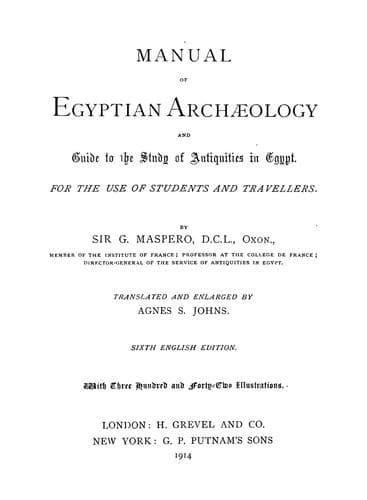
Manual of Egyptian Archaeology and Guide to the Study of Antiquities in EgyptMaspero, G. (Gaston)
History
Manual of Egyptian Archaeology and Guide to the Study of Antiquities in Egypt
Maspero, G. (Gaston)
Art -- Egypt; Egypt -- Antiquities
They were weighed by the god Thoth, who consigned them to their future
abode according to the verdict of the scales. The sinful Soul was handed
over to the cynocephalous-ape assessors of the infernal tribunal, who
hunted and scourged it, after first changing it into a sow, or some other
impure animal. The righteous Soul, on the contrary, passed in the fifth
hour into the company of his fellows, whose task it was to cultivate the
Fields of Aalû and reap the corn of the celestial harvest, after which they
took their pleasure under the guardianship of the good genii. After the
fifth hour, the heavenly ocean became a vast battlefield. The gods of
light pursued, captured, and bound the serpent Apapi, and at the
twelfth hour they strangled him. But this triumph was not of long duration.
Scarcely had the sun achieved this victory when his bark was borne by the
tide into the realm of the night hours, and from that moment he was
assailed, like Virgil and Dante at the Gates of Hell, by frightful sounds
and clamourings. Each circle had its voice, not to be confounded with the
voices of other circles. Here the sound was as an immense humming of wasps;
yonder it was as the lamentations of women for their husbands, and the
howling of she-beasts for their mates; elsewhere it was as the rolling of
the thunder. The sarcophagus, as well as the walls, was covered with these
scenes of joyous or sinister import. It was generally of red or black
granite. As it was put in hand last of all, it frequently happened that the
sculptors had not time to finish it. When finished, however, the scenes and
texts with which it was covered contained an epitome of the whole
catacomb.[34] Thus, lying in his sarcophagus, the dead man found his future
destinies depicted thereon, and learned to understand the blessedness of
the gods. The tombs of private persons were not often so elaborately
decorated. Two tombs of the period of the Twenty-sixth Dynasty--that of
Petamenoph at Thebes and that of Bakenrenf at Memphis--compete in this
respect, however, with the royal catacombs. Their walls are not only
sculptured with the text (more or less complete) of _The Book of the Dead_,
but also with long extracts from _The Book of the Opening of the Mouth_ and
the religious formulae found in the pyramids.
Public-domain text, read in full here on John Shaqi.
Reviews
Reviews
No reviews yet
Be the first to share your thoughts on this work.
Elsewhere in the archive
Join the Discussion
Join the discussion
Sign in to leave a comment or review.
Sign InorCreate an account