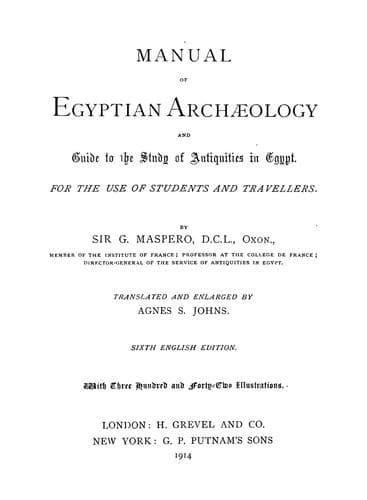
Manual of Egyptian Archaeology and Guide to the Study of Antiquities in EgyptMaspero, G. (Gaston)
History
Manual of Egyptian Archaeology and Guide to the Study of Antiquities in Egypt
Maspero, G. (Gaston)
Art -- Egypt; Egypt -- Antiquities
[33] M. Léfébure has lately produced a superb and elaborate volume on this
tomb, with the whole of the texts and the wall decorations faithfully
reproduced: _Mémoires publiés par les Membres de la Mission du
Caire_, Vol. II., fasc. I.--A.B.E.
[34] We have in this country two very fine specimens of inscribed
sarcophagi; namely, that of Seti I., of beautiful alabaster, in the
Soane collection (xixth Dyn.), and that of Queen Ankhnesraneferab
(xxvith Dyn.) in the British Museum.--A.B.E.
CHAPTER IV.
_PAINTING AND SCULPTURE_.
The statues and bas-reliefs which decorated the temples and tombs of
Ancient Egypt were for the most part painted. Coloured stones, such as
granite, basalt, diorite, serpentine, and alabaster, sometimes escaped this
law of polychrome; but in the case of sandstone, limestone, or wood it was
rigorously enforced. If sometimes we meet with uncoloured monuments in
these materials, we may be sure that the paint has been accidentally rubbed
off, or that the work is unfinished. The sculptor and the painter were
therefore inseparably allied. The first had no sooner finished his share of
the task than the other took it up; and the same artist was often as
skilful a master of the brush as of the chisel.
I.--DRAWING AND COMPOSITION.
Of the system upon which drawing was taught by the Egyptian masters, we
know nothing. They had learned from experience to determine the general
proportions of the body, and the invariable relations of the various parts
one with another; but they never troubled themselves to tabulate those
proportions, or to reduce them to a system. Nothing in what remains to us
of their works justifies the belief that they ever possessed a canon based
upon the length of the human finger or foot. Theirs was a teaching of
routine, and not of theory. Models executed by the master were copied over
and over again by his pupils, till they could reproduce them with absolute
exactness. That they also studied from the life is shown by the facility
with which they seized a likeness, or rendered the characteristics and
movements of different kinds of animals. They made their first attempts
upon slabs of limestone, on drawing boards covered with a coat of red or
white stucco, or on the backs of old manuscripts of no value. New papyrus
was too dear to be spoiled by the scrawls of tyros. Having neither pencil
nor stylus, they made use of the reed, the end of which, when steeped in
water, opened out into small fibres, and made a more or less fine brush
according to the size of the stem. The palette was of thin wood, in shape a
rectangular oblong, with a groove in which to lay the brush at the lower
end. At the upper end were two or more cup-like hollows, each fitted with a
cake of ink; black and red being the colours most in use. A tiny pestle and
mortar for colour-grinding (fig. 160), and a cup of water in which to clip
and wash the brush, completed the apparatus of the student. Palette in
Public-domain text, read in full here on John Shaqi.
Reviews
Reviews
No reviews yet
Be the first to share your thoughts on this work.
Elsewhere in the archive
Join the Discussion
Join the discussion
Sign in to leave a comment or review.
Sign InorCreate an account