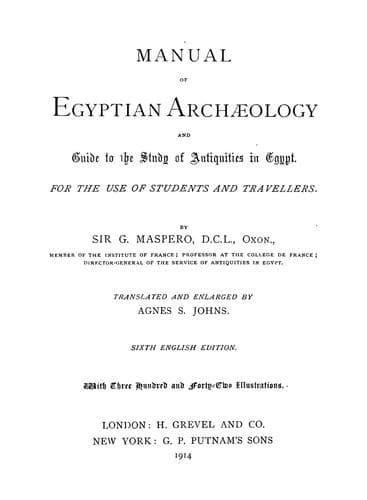
Manual of Egyptian Archaeology and Guide to the Study of Antiquities in EgyptMaspero, G. (Gaston)
History
Manual of Egyptian Archaeology and Guide to the Study of Antiquities in Egypt
Maspero, G. (Gaston)
Art -- Egypt; Egypt -- Antiquities
whose hereditary profession it was to conduct the services for the dead.
When making these illustrations, the artist had no occasion to draw upon
his imagination. He had but to imitate the copy as skilfully as he could.
Of _The Book of Knowing That which is in Hades_ we have no examples earlier
than the time of the Twentieth Dynasty, and these are poor enough in point
of workmanship, the figures being little better than dot-and-line forms,
badly proportioned and hastily scrawled. The extant specimens of _The Book
of the Dead_ are so numerous that a history of the art of miniature
painting in ancient Egypt might be compiled from this source alone. The
earliest date from the Eighteenth Dynasty, the more recent being
contemporary with the first Caesars. The oldest copies are for the most
part remarkably fine in execution. Each chapter has its vignette
representing a god in human or animal form, a sacred emblem, or the
deceased in adoration before a divinity. These little subjects are
sometimes ranged horizontally at the top of the text, which is written in
vertical columns (fig. 162); sometimes, like the illuminated capitals in
our mediaeval manuscripts, they are scattered throughout the pages. At
certain points, large subjects fill the space from top to bottom of the
papyrus. The burial scene comes at the beginning; the judgment of the soul
about the middle; and the arrival of the deceased in the Fields of Aalû at
the end of the work. In these, the artist seized the opportunity to display
his skill, and show what he could do. We here see the mummy of Hûnefer
placed upright before his stela and his tomb (fig. 163). The women of his
family bewail him; the men and the priest present offerings. The papyri of
the princes and princesses of the family of Pinotem in the Museum of Gizeh
show that the best traditions of the art were yet in force at Thebes in the
time of the Twenty-first Dynasty. Under the succeeding dynasties, that art
fell into rapid decadence, and during some centuries the drawings continue
to be coarse and valueless. The collapse of the Persian rule produced a
period of Renaissance. Tombs of the Greek time have yielded papyri with
vignettes carefully executed in a dry and minute style which offers a
singular contrast to the breadth and boldness of the Pharaonic ages. The
broad-tipped reed-pen was thrown aside for the pen with a fine point, and
the scribes vied with each other as to which should trace the most
attenuated lines. The details with which they overloaded their figures, the
elaboration of the beard and the hair, and the folds of the garments, are
sometimes so minute that it is scarcely possible to distinguish them
without a magnifying glass. Precious as these documents are, they give a
very insufficient idea of the ability and technical methods of the artists
of ancient Egypt. It is to the walls of their temples and tombs that we
must turn, if we desire to study their principles of composition.
Public-domain text, read in full here on John Shaqi.
Reviews
Reviews
No reviews yet
Be the first to share your thoughts on this work.
Elsewhere in the archive
Join the Discussion
Join the discussion
Sign in to leave a comment or review.
Sign InorCreate an account