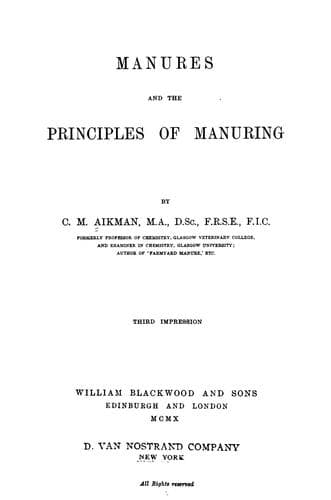
Manures and the principles of manuringAikman, Charles Morton
Science
Manures and the principles of manuring
Aikman, Charles Morton
Fertilizers; Manures
Many of these processes were tried; but it was found by experiment that
the best and most economical way was by applying the slag direct to the
ground in a state of very fine powder. Experiments further showed that
it had _not_ the injurious effect on vegetation which it was feared it
would have from the protoxide of iron it contained. The discovery that
its phosphoric acid existed, as has been already explained, as a
tetrabasic phosphate of lime, has strengthened the opinion that this is
the best method of application.
A good deal has been found to depend upon the fineness of the ground
slag, with the result that it is now commonly sold on a mechanical as
well as a chemical analysis--_i.e._, the slag is guaranteed to pass
through a sieve of a certain fineness.
_Solubility of Slag._
Professor Wagner of Darmstadt has carried out some extremely interesting
experiments on the solubility of slag. He found that very finely
powdered slag was dissolved in carbonic acid water to the extent of 36
per cent, while, similarly treated, phosphorite only dissolved to the
extent of 8 per cent.[235] Another very important solvent is _citrate of
ammonia_. Reverted (or precipitated) phosphate is entirely soluble in
it, and phosphate soluble in it ought to be valued as worth more than
that which is not. Now, the solubility of Thomas-slag in citrate of
ammonia was found by Professor Wagner to be no less than 74 per cent,
while that of phosphorite only amounted to 4 per cent. These results
were corroborated by Professor S. W. Johnson, who found that of the
19.87 per cent of phosphoric acid contained in a sample of basic slag,
no less than 19.57 per cent was soluble in ammonium citrate, while a
finely ground sample of phosphatic rock yielded, on analysis, only 1.81
per cent soluble in citrate of ammonia, of a total of 29.49 per cent
phosphoric acid which it contained. Professor Fleischer has also tested
the comparative solubility of basic slag and phosphorite, by boiling
them in a solution of acetic acid. The former was found to have been
dissolved to the extent of 19 per cent, while the latter to only 5 per
cent. A highly interesting and most important experiment was performed
by Mr Heinrich Albert, of Biebrich. One gramme of basic slag and 100
grammes of peat were mixed together in a litre of water, and it was
found that, after standing for fourteen days, 79 per cent of the
phosphoric acid contained in the slag was rendered soluble.
Public-domain text, read in full here on John Shaqi.
Reviews
Reviews
No reviews yet
Be the first to share your thoughts on this work.
Elsewhere in the archive
Join the Discussion
Join the discussion
Sign in to leave a comment or review.
Sign InorCreate an account