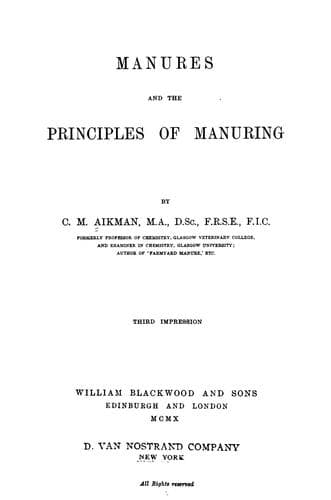
Manures and the principles of manuringAikman, Charles Morton
Science
Manures and the principles of manuring
Aikman, Charles Morton
Fertilizers; Manures
As to the rate per acre at which the slag ought to be applied, there
will naturally be a difference of opinion. Professor Wrightson, of
Downton Agricultural College, recommends that it should be applied at
the rate of from 6 to 10 cwt. per acre. This, of course, is very
liberal manuring. We must remember, however, that phosphatic manures,
unlike nitrogenous manures, and to some extent potash manures, may be
applied in even excessive quantities without any risk of loss. It is
impossible to measure out our phosphate manures in the same accurate
manner as we measure out our nitrogen. It is safer, therefore, and on
that account more economical in the long-run, to apply our phosphate in
excessive quantity than the reverse. The reason of this may be shortly
explained. The phosphoric acid which is naturally present in most soils
is with difficulty soluble. Only a small quantity is yielded daily to
the plant. This quantity may, under favourable climatic conditions, be
sufficient; but these favourable influences never last very long at a
time.
For three weeks, perhaps, the plant may experience drought, and during
this period it takes up no phosphoric acid, and its growth practically
comes to a standstill; but this period of drought is followed by rain
and warm weather, and the plant, if it is to be ripe by harvest-time,
must make up for lost time. It must grow as much the next few days under
these favourable climatic conditions as it would have grown under normal
conditions in double or treble the time. In order to do so, however, it
must be able to obtain plenty of phosphoric acid, and this is only
possible where there is a decided excess of phosphoric acid present in
the soil.
The richness of a soil, therefore, in phosphoric acid, must be such
that it is not only able to supply the ordinary wants of the plant, but
to provide an excess when such an excess will be needed; for one must
remember that the amount of plant-substance formed in the course of a
few days under favourable conditions is very great, and that the amount
consequently of phosphoric acid which plants assimilate during that
period must also be very considerable.
_Method of Application._
In conclusion, as to the method of application of the slag,
agriculturists must be _warned against mixing it with sulphate of
ammonia_; for if this is done, a _considerable loss of ammonia_ will
ensue, set free from the sulphate by the action of the free lime which
the Thomas-slag contains. With nitrate of soda and potash salts it may
be freely mixed. Such mixtures, however, are apt to form themselves into
little balls, which soon become very hard. They should therefore only be
mixed shortly before use. To overcome this difficulty, Professor Wagner
recommends the mixture of a little peat or sawdust with the slag.
FOOTNOTES:
[233] See Appendix, p. 417.
[234] _Vide_ paper on "Basic Slag: Its Formation." By Stead and
Ribsdale. 'Journal of the Iron and Steel Institute,' 1887, p. 230.
Public-domain text, read in full here on John Shaqi.
Reviews
Reviews
No reviews yet
Be the first to share your thoughts on this work.
Elsewhere in the archive
Join the Discussion
Join the discussion
Sign in to leave a comment or review.
Sign InorCreate an account