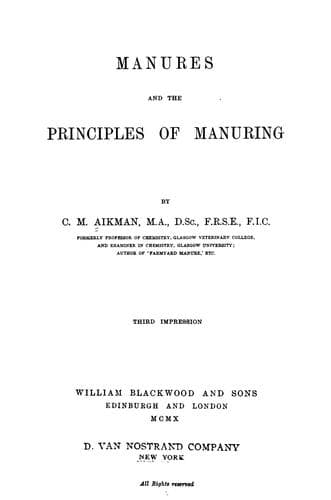
Manures and the principles of manuringAikman, Charles Morton
Science
Manures and the principles of manuring
Aikman, Charles Morton
Fertilizers; Manures
Of soils best suited for potash manures, it has been found that light
soils, and those largely charged with peaty organic matter (such as the
moorland soils of Germany), are most benefited; while on heavy clayey
soils the percentage of potash which these latter contain is already
sufficiently abundant for the needs of plants. At Flitcham the value of
potash on chalk soils has been strikingly demonstrated. Of crops, it is
now pretty generally acknowledged that those of the leguminous order are
most benefited by potash. Especially in the case of clover has potash
always proved itself a manure worth applying.
_Rate of Application._
Potash is best applied in small quantities. From 1 to 2 cwt. of the
muriate or sulphate is a common amount, and from 6 to 8 cwt. of kainit.
CHAPTER XVI.
MINOR ARTIFICIAL MANURES.
In addition to the manures which have been discussed in previous
chapters, there are a number of minor manures which are used to a very
much smaller extent--dried blood, hoofs, horns, &c.
Among these one of the most valuable is dried blood. Fresh blood,
containing 80 per cent of water, has from 2.5 to 3 per cent of nitrogen,
about .25 per cent of phosphoric acid, and about .5 per cent of
alkalies. When dried it forms a very concentrated and valuable
nitrogenous manure, which has long been used in France. The commercial
article contains, on an average, about 12 per cent of nitrogen, and
slightly over 1 per cent of phosphoric acid. When mixed with the soil it
ferments, and the nitrogen it contains is converted into ammonia.
Although not so quick-acting a manure as nitrate of soda or sulphate of
ammonia, it can by no means be described, as is done in ordinary
agricultural text-books, as a slow-acting manure. Its nitrogen may be
regarded as of equal value to that in Peruvian guano. It is peculiarly
suited for horticulture, and is chiefly used in this country as a manure
for hops. It has also been used with beneficial results for wheat,
grass, and turnips. As a manure it is best suited for sandy or loamy
soils. Considerable quantities are exported to the sugar-growing
colonies as a manure for sugar-cane. Manures are made from other animal
refuse. It may be mentioned that lean flesh (containing 75 per cent of
water) has about 3 to 4 per cent of nitrogen,.5 per cent of alkalies,
and .5 per cent of phosphoric acid; that is to say, a ton of lean flesh
would contain about 70 lb. of nitrogen and 10 lb. of phosphoric acid. In
air-dried flesh, according to Payen and Boussingault (containing 8-1/2
per cent of moisture), there is 13 per cent of nitrogen. Flesh,
therefore, is, when properly composted, a valuable nitrogenous manure.
Dried flesh is generally made into a manure called meat-meal guano, the
composition of which we have already referred to in the chapter on
Guano.[240]
Public-domain text, read in full here on John Shaqi.
Reviews
Reviews
No reviews yet
Be the first to share your thoughts on this work.
Elsewhere in the archive
Join the Discussion
Join the discussion
Sign in to leave a comment or review.
Sign InorCreate an account