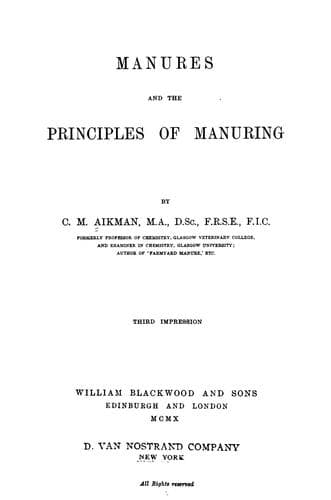
Manures and the principles of manuringAikman, Charles Morton
Science
Manures and the principles of manuring
Aikman, Charles Morton
Fertilizers; Manures
Nitrogen, phosphoric acid, and potash exist in the common manures, as
has already been pointed out, in different states of availability.
Nitrogen, for example, may exist in a soluble or insoluble condition, as
nitrates, as ammonia, or in various organic forms. Phosphoric acid,
similarly, may exist in a soluble form, as it does in superphosphate of
lime, or in an insoluble form, as it does in bones or basic slag.
Potash, on the other hand, exists--or should exist--in artificial
manures only in a soluble form. Now a correct knowledge of the behaviour
of these different forms of the common manurial ingredients when applied
to the soil is, in the first place, necessary for their successful and
economical use.
_Nitrogenous Manures._
Thus our knowledge of the inability of the soil-particles to retain
nitrogen in the form of nitric acid, as well as our knowledge of the
fact that nitrogen is in this form immediately available for the
plant's needs, teaches us that nitrate of soda should never be applied
before the plant is ready to utilise it--in short, that it should only
be applied as a top-dressing; and further, that the use of such a
fertiliser in a damp season is less likely to be economical than in a
dry one. Again, with regard to nitrogen in the form of ammonia salts,
our knowledge of the fact that ammonia is retained by the
soil-particles, and that before it becomes available for the plant's
needs it has to undergo the process of nitrification, teaches us the
desirability of applying it a short time before it is likely to be used.
While, lastly, with regard to the nitrogen in the various organic forms
in which it occurs, our knowledge of the rate at which these are
converted into an available form in the soil will determine when they
are best applied. Some forms of organic nitrogen are in a soluble
condition, and are quite as speedy in their action as sulphate of
ammonia. This is the case with a considerable proportion of the
different organic forms of nitrogen present in guano. Other forms of
organic nitrogen are only slightly less so--as, for example, dried
blood, which ferments very speedily. With regard, therefore, to nitrates
and ammonia salts, as well as the more quickly available organic forms
of nitrogen, they should either be applied as a top-dressing after the
plant has started growth, or only shortly before seed-time. Bones,
shoddy, and the various so-called native guanos, should be applied a
considerable period before they are likely to be required--not later
than the previous autumn.
_Phosphatic Manures._
Public-domain text, read in full here on John Shaqi.
Reviews
Reviews
No reviews yet
Be the first to share your thoughts on this work.
Elsewhere in the archive
Join the Discussion
Join the discussion
Sign in to leave a comment or review.
Sign InorCreate an account