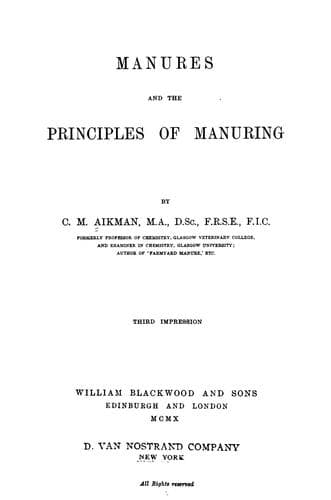
Manures and the principles of manuringAikman, Charles Morton
Science
Manures and the principles of manuring
Aikman, Charles Morton
Fertilizers; Manures
One explanation of the different capacity possessed by different crops
for absorbing plant-food from the soil is to be found in the difference
of their root systems. Every agriculturist knows that crops in this
respect differ very widely. Crops having deep roots will naturally have
a larger surface of soil from which to draw their food-supplies than
crops having shallower roots. Such crops as red clover, wheat, and
mangels are able to draw their food-supplies from the subsoil to an
extent not possessed by shallower-rooted crops, such as barley, turnips,
and grass. Crops having surface-roots, on the other hand, have often
greater capacity for assimilating nitrogen,--this ingredient, as has
already been pointed out, being chiefly located in the surface-soil. The
tendency of growing shallow-rooted crops will therefore be towards
impoverishing the surface-soil; whereas the occasional growth of a
deep-rooted crop brings the plant-food in the subsoil into requisition.
In this connection it may be well to draw attention to the singular
capacity possessed by certain crops for absorbing nitrogen. Of these the
case of clover is the most striking, and has long puzzled
agriculturists. The discovery, which has been repeatedly referred to in
these pages, that the leguminous order of crops, to which clover
belongs, have the power of absorbing the free nitrogen of the air
through the agency of micro-organic life in the plant and in the soil,
has furnished an explanation of this long-debated problem.
_Period of Growth._
A further reason is the difference in the period of a crop's growth. A
crop which grows quickly, and consequently occupies the ground during a
comparatively short period, will naturally require a richer soil, and
therefore a more liberal treatment with manure, than one whose growth is
more gradual.
Public-domain text, read in full here on John Shaqi.
Reviews
Reviews
No reviews yet
Be the first to share your thoughts on this work.
Elsewhere in the archive
Join the Discussion
Join the discussion
Sign in to leave a comment or review.
Sign InorCreate an account