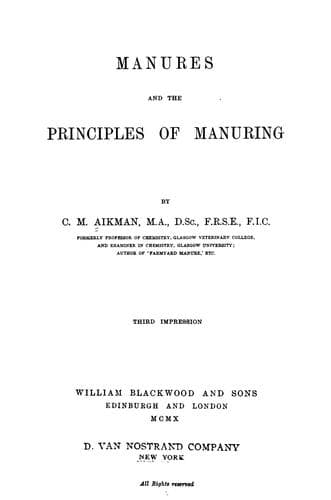
Manures and the principles of manuringAikman, Charles Morton
Science
Manures and the principles of manuring
Aikman, Charles Morton
Fertilizers; Manures
The form in which nitrogen is present in the plant is chiefly as
albuminoids. As, however, albuminoids belong to that class of bodies
known as colloids, which cannot easily pass through porous membranes
like those forming the walls of plant-cells, they are changed during
certain periods of the plant's growth into amides, which are
crystalloids, and consequently able to move freely about in the plant.
Amides are most abundant in young plants during the period of their most
active growth, and as the plant ripens the amides seem to be largely
converted into albuminoids.
While the subject is not very clearly understood, it would seem to be
pretty conclusively proved that there is a direct relation between the
amount of the phosphoric acid and of the nitrogen absorbed.
_Bearing of above Facts on Agricultural Practice._
The bearing of these facts upon practice is obvious. In the first place,
they show how important it is that plants should be well fed when they
are young, and that in the practice of green manuring it is best to
plough in the crop when it is in flower, as no additional benefit is
gained by allowing it to ripen, seeing that no further absorption of
fertilising ingredients takes place after the period of flowering.
_Influence of excessive Manuring of Crops._
The influence of large quantities of manures is seen in the case of
certain root crops. It is found, in such a case, that while the roots
are larger, they are more watery in composition and of less nutritive
value. Again, it seems to be a fact pretty generally known to practical
men, that nitrate of soda seems to have a bad effect on the quality of
hay. It would seem, further, that the influence of nitrogenous
fertilisers on cereals is to increase the percentage of nitrogen in the
grain, but that they have no such influence in the case of leguminous
crops. Phosphatic manures, on the other hand, in the case of leguminous
crops, seem to have the effect of diminishing the amount of nitrogen in
the seed.
FOOTNOTES:
[241] Though not necessarily at the same time or to each succeeding
crop. There may be comparatively long intervals between the applications
of farmyard manure in many cases.
[242] Of course what is meant here is the direct influence of such
manures. Their indirect value may be shown in the soil by the increased
crop residues they give rise to.
[243] This is very concisely and clearly put in Mr Warington's admirable
'Chemistry of the Farm.'
CHAPTER XXIII.
MANURING OF THE COMMON FARM CROPS.
In this chapter we shall attempt to summarise briefly the results of
experiments on the manuring of some of the commoner crops, and we shall
start with the manuring of cereals.
CEREALS.
Public-domain text, read in full here on John Shaqi.
Reviews
Reviews
No reviews yet
Be the first to share your thoughts on this work.
Elsewhere in the archive
Join the Discussion
Join the discussion
Sign in to leave a comment or review.
Sign InorCreate an account