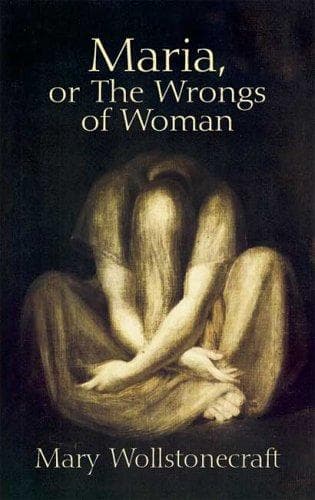
Maria; Or, The Wrongs of WomanWollstonecraft, Mary
General
Maria; Or, The Wrongs of Woman
Wollstonecraft, Mary
Autobiographical fiction; Feminist fiction; Women -- Fiction
“My eldest brother was articled to a neighbouring attorney, the
shrewdest, and, I may add, the most unprincipled man in that part of
the country. As my brother generally came home every Saturday, to
astonish my mother by exhibiting his attainments, he gradually assumed
a right of directing the whole family, not excepting my father. He
seemed to take a peculiar pleasure in tormenting and humbling me; and
if I ever ventured to complain of this treatment to either my father or
mother, I was rudely rebuffed for presuming to judge of the conduct of
my eldest brother.
“About this period a merchant’s family came to settle in our
neighbourhood. A mansion-house in the village, lately purchased, had
been preparing the whole spring, and the sight of the costly furniture,
sent from London, had excited my mother’s envy, and roused my father’s
pride. My sensations were very different, and all of a pleasurable
kind. I longed to see new characters, to break the tedious monotony of
my life; and to find a friend, such as fancy had pourtrayed. I cannot
then describe the emotion I felt, the Sunday they made their appearance
at church. My eyes were rivetted on the pillar round which I expected
first to catch a glimpse of them, and darted forth to meet a servant
who hastily preceded a group of ladies, whose white robes and waving
plumes, seemed to stream along the gloomy aisle, diffusing the light,
by which I contemplated their figures.
“We visited them in form; and I quickly selected the eldest daughter
for my friend. The second son, George, paid me particular attention,
and finding his attainments and manners superior to those of the young
men of the village, I began to imagine him superior to the rest of
mankind. Had my home been more comfortable, or my previous acquaintance
more numerous, I should not probably have been so eager to open my
heart to new affections.
“Mr. Venables, the merchant, had acquired a large fortune by
unremitting attention to business; but his health declining rapidly, he
was obliged to retire, before his son, George, had acquired sufficient
experience, to enable him to conduct their affairs on the same
prudential plan, his father had invariably pursued. Indeed, he had
laboured to throw off his authority, having despised his narrow plans
and cautious speculation. The eldest son could not be prevailed on to
enter the firm; and, to oblige his wife, and have peace in the house,
Mr. Venables had purchased a commission for him in the guards.
Public-domain text, read in full here on John Shaqi.
Reviews
Reviews
No reviews yet
Be the first to share your thoughts on this work.
Join the Discussion
Join the discussion
Sign in to leave a comment or review.
Sign InorCreate an account