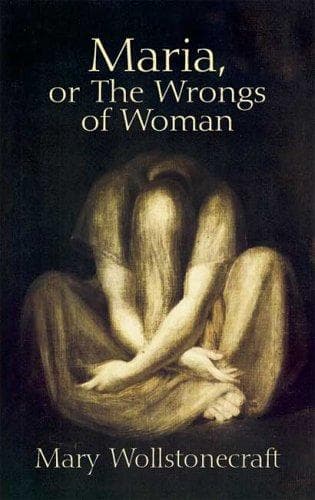
Maria; Or, The Wrongs of WomanWollstonecraft, Mary
General
Maria; Or, The Wrongs of Woman
Wollstonecraft, Mary
Autobiographical fiction; Feminist fiction; Women -- Fiction
“I am now alluding to circumstances which came to my knowledge long
after; but it is necessary, my dearest child, that you should know the
character of your father, to prevent your despising your mother; the
only parent inclined to discharge a parent’s duty. In London, George
had acquired habits of libertinism, which he carefully concealed from
his father and his commercial connections. The mask he wore, was so
complete a covering of his real visage, that the praise his father
lavished on his conduct, and, poor mistaken man! on his principles,
contrasted with his brother’s, rendered the notice he took of me
peculiarly flattering. Without any fixed design, as I am now convinced,
he continued to single me out at the dance, press my hand at parting,
and utter expressions of unmeaning passion, to which I gave a meaning
naturally suggested by the romantic turn of my thoughts. His stay in
the country was short; his manners did not entirely please me; but,
when he left us, the colouring of my picture became more vivid—Whither
did not my imagination lead me? In short, I fancied myself in love—in
love with the disinterestedness, fortitude, generosity, dignity, and
humanity, with which I had invested the hero I dubbed. A circumstance
which soon after occurred, rendered all these virtues palpable. [The
incident is perhaps worth relating on other accounts, and therefore I
shall describe it distinctly.]
“I had a great affection for my nurse, old Mary, for whom I used often
to work, to spare her eyes. Mary had a younger sister, married to a
sailor, while she was suckling me; for my mother only suckled my eldest
brother, which might be the cause of her extraordinary partiality.
Peggy, Mary’s sister, lived with her, till her husband, becoming a mate
in a West-Indian trader, got a little before-hand in the world. He
wrote to his wife from the first port in the Channel, after his most
successful voyage, to request her to come to London to meet him; he
even wished her to determine on living there for the future, to save
him the trouble of coming to her the moment he came on shore; and to
turn a penny by keeping a green-stall. It was too much to set out on a
journey the moment he had finished a voyage, and fifty miles by land,
was worse than a thousand leagues by sea.
“She packed up her alls, and came to London—but did not meet honest
Daniel. A common misfortune prevented her, and the poor are bound to
suffer for the good of their country—he was pressed in the river—and
never came on shore.
Public-domain text, read in full here on John Shaqi.
Reviews
Reviews
No reviews yet
Be the first to share your thoughts on this work.
Join the Discussion
Join the discussion
Sign in to leave a comment or review.
Sign InorCreate an account