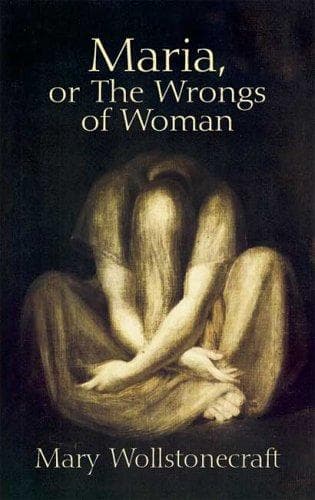
Maria; Or, The Wrongs of WomanWollstonecraft, Mary
General
Maria; Or, The Wrongs of Woman
Wollstonecraft, Mary
Autobiographical fiction; Feminist fiction; Women -- Fiction
“During the breakfast, he attempted to reason with me on the folly of
romantic sentiments; for this was the indiscriminate epithet he gave to
every mode of conduct or thinking superior to his own. He asserted,
‘that all the world were governed by their own interest; those who
pretended to be actuated by different motives, were only deeper knaves,
or fools crazed by books, who took for gospel all the rodomantade
nonsense written by men who knew nothing of the world. For his part, he
thanked God, he was no hypocrite; and, if he stretched a point
sometimes, it was always with an intention of paying every man his
own.’
“He then artfully insinuated, ‘that he daily expected a vessel to
arrive, a successful speculation, that would make him easy for the
present, and that he had several other schemes actually depending, that
could not fail. He had no doubt of becoming rich in a few years, though
he had been thrown back by some unlucky adventures at the setting out.’
“I mildly replied, ‘That I wished he might not involve himself still
deeper.’
“He had no notion that I was governed by a decision of judgment, not to
be compared with a mere spurt of resentment. He knew not what it was to
feel indignation against vice, and often boasted of his placable
temper, and readiness to forgive injuries. True; for he only considered
the being deceived, as an effort of skill he had not guarded against;
and then, with a cant of candour, would observe, ‘that he did not know
how he might himself have been tempted to act in the same
circumstances.’ And, as his heart never opened to friendship, it never
was wounded by disappointment. Every new acquaintance he protested, it
is true, was ‘the cleverest fellow in the world; and he really thought
so; till the novelty of his conversation or manners ceased to have any
effect on his sluggish spirits. His respect for rank or fortune was
more permanent, though he chanced to have no design of availing himself
of the influence of either to promote his own views.
“After a prefatory conversation,—my blood (I thought it had been
cooler) flushed over my whole countenance as he spoke—he alluded to my
situation. He desired me to reflect—‘and act like a prudent woman, as
the best proof of my superior understanding; for he must own I had
sense, did I know how to use it. I was not,’ he laid a stress on his
words, ‘without my passions; and a husband was a convenient cloke.—He
was liberal in his way of thinking; and why might not we, like many
other married people, who were above vulgar prejudices, tacitly consent
to let each other follow their own inclination?—He meant nothing more,
in the letter I made the ground of complaint; and the pleasure which I
seemed to take in Mr. S.‘s company, led him to conclude, that he was
not disagreeable to me.’
Public-domain text, read in full here on John Shaqi.
Reviews
Reviews
No reviews yet
Be the first to share your thoughts on this work.
Elsewhere in the archive
Join the Discussion
Join the discussion
Sign in to leave a comment or review.
Sign InorCreate an account