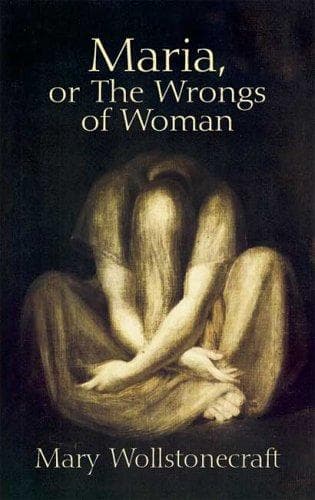
Maria; Or, The Wrongs of WomanWollstonecraft, Mary
General
Maria; Or, The Wrongs of Woman
Wollstonecraft, Mary
Autobiographical fiction; Feminist fiction; Women -- Fiction
“To avoid all danger of detection—I use the appropriate word, my child,
for I was hunted out like a felon—I determined to take possession of my
new lodgings that very evening.
“I did not inform my landlady where I was going. I knew that she had a
sincere affection for me, and would willingly have run any risk to show
her gratitude; yet I was fully convinced, that a few kind words from
Johnny would have found the woman in her, and her dear benefactress, as
she termed me in an agony of tears, would have been sacrificed, to
recompense her tyrant for condescending to treat her like an equal. He
could be kind-hearted, as she expressed it, when he pleased. And this
thawed sternness, contrasted with his habitual brutality, was the more
acceptable, and could not be purchased at too dear a rate.
“The sight of the advertisement made me desirous of taking refuge with
my uncle, let what would be the consequence; and I repaired in a
hackney coach (afraid of meeting some person who might chance to know
me, had I walked) to the chambers of my uncle’s friend.
“He received me with great politeness (my uncle had already
prepossessed him in my favour), and listened, with interest, to my
explanation of the motives which had induced me to fly from home, and
skulk in obscurity, with all the timidity of fear that ought only to be
the companion of guilt. He lamented, with rather more gallantry than,
in my situation, I thought delicate, that such a woman should be thrown
away on a man insensible to the charms of beauty or grace. He seemed at
a loss what to advise me to do, to evade my husband’s search, without
hastening to my uncle, whom, he hesitating said, I might not find
alive. He uttered this intelligence with visible regret; requested me,
at least, to wait for the arrival of the next packet; offered me what
money I wanted, and promised to visit me.
“He kept his word; still no letter arrived to put an end to my painful
state of suspense. I procured some books and music, to beguile the
tedious solitary days.
‘Come, ever smiling Liberty,
‘And with thee bring thy jocund train:’
I sung—and sung till, saddened by the strain of joy, I bitterly
lamented the fate that deprived me of all social pleasure. Comparative
liberty indeed I had possessed myself of; but the jocund train lagged
far behind!”
CHAPTER 13
“By watching my only visitor, my uncle’s friend, or by some other
means, Mr. Venables discovered my residence, and came to enquire for
me. The maid-servant assured him there was no such person in the house.
A bustle ensued—I caught the alarm—listened—distinguished his voice,
and immediately locked the door. They suddenly grew still; and I waited
near a quarter of an hour, before I heard him open the parlour door,
and mount the stairs with the mistress of the house, who obsequiously
declared that she knew nothing of me.
Public-domain text, read in full here on John Shaqi.
Reviews
Reviews
No reviews yet
Be the first to share your thoughts on this work.
Elsewhere in the archive
Join the Discussion
Join the discussion
Sign in to leave a comment or review.
Sign InorCreate an account