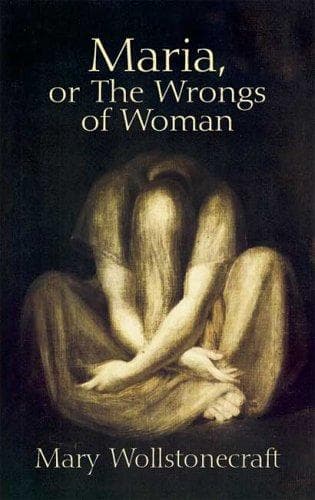
Maria; Or, The Wrongs of WomanWollstonecraft, Mary
General
Maria; Or, The Wrongs of Woman
Wollstonecraft, Mary
Autobiographical fiction; Feminist fiction; Women -- Fiction
[10] Two and a half lines of asterisks appear here in the original
[Publisher’s note].
“They were scarcely out of the house, when my landlady came up to me
again, and begged my pardon, in a very different tone. For, though Mr.
Venables had bid her, at her peril, harbour me, he had not attended, I
found, to her broad hints, to discharge the lodging. I instantly
promised to pay her, and make her a present to compensate for my abrupt
departure, if she would procure me another lodging, at a sufficient
distance; and she, in return, repeating Mr. Venables’ plausible tale, I
raised her indignation, and excited her sympathy, by telling her
briefly the truth.
“She expressed her commiseration with such honest warmth, that I felt
soothed; for I have none of that fastidious sensitiveness, which a
vulgar accent or gesture can alarm to the disregard of real kindness. I
was ever glad to perceive in others the humane feelings I delighted to
exercise; and the recollection of some ridiculous characteristic
circumstances, which have occurred in a moment of emotion, has
convulsed me with laughter, though at the instant I should have thought
it sacrilegious to have smiled. Your improvement, my dearest girl,
being ever present to me while I write, I note these feelings, because
women, more accustomed to observe manners than actions, are too much
alive to ridicule. So much so, that their boasted sensibility is often
stifled by false delicacy. True sensibility, the sensibility which is
the auxiliary of virtue, and the soul of genius, is in society so
occupied with the feelings of others, as scarcely to regard its own
sensations. With what reverence have I looked up at my uncle, the dear
parent of my mind! when I have seen the sense of his own sufferings, of
mind and body, absorbed in a desire to comfort those, whose misfortunes
were comparatively trivial. He would have been ashamed of being as
indulgent to himself, as he was to others. ‘Genuine fortitude,’ he
would assert, ‘consisted in governing our own emotions, and making
allowance for the weaknesses in our friends, that we would not tolerate
in ourselves.’ But where is my fond regret leading me!
“‘Women must be submissive,’ said my landlady. ‘Indeed what could most
women do? Who had they to maintain them, but their husbands? Every
woman, and especially a lady, could not go through rough and smooth, as
she had done, to earn a little bread.’
“She was in a talking mood, and proceeded to inform me how she had been
used in the world. ‘She knew what it was to have a bad husband, or she
did not know who should.’ I perceived that she would be very much
mortified, were I not to attend to her tale, and I did not attempt to
interrupt her, though I wished her, as soon as possible, to go out in
search of a new abode for me, where I could once more hide my head.
Public-domain text, read in full here on John Shaqi.
Reviews
Reviews
No reviews yet
Be the first to share your thoughts on this work.
Elsewhere in the archive
Join the Discussion
Join the discussion
Sign in to leave a comment or review.
Sign InorCreate an account