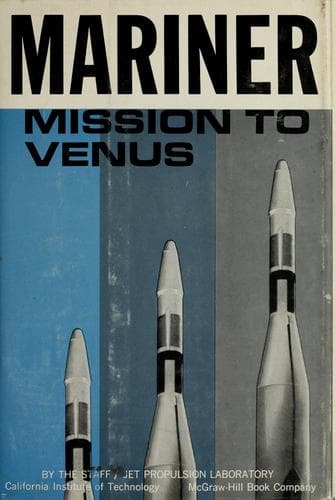
Mariner Mission to VenusJet Propulsion Laboratory (U.S.)
Science
Mariner Mission to Venus
Jet Propulsion Laboratory (U.S.)
Project Mariner (U.S.)
In order to complement the Mariner mission to Venus, the radar
experiments were repeated from October to December, 1962 (during the
Mariner mission), using improved equipment and refined techniques. As in
1961, the experiments were directed by W. K. Victor and R. Stevens.
The 1961 experiments used two 85-foot antennas, one transmitting 13
kilowatts of power at 2,388 megacycles, the other receiving the return
signal after the round trip to and from Venus. The most important result
was the refinement of the astronomical unit—the mean distance from the
Earth to the Sun—to a value of 92,956,200 ±300 miles.
Around 1910, the astronomical unit, plotted by classical optical
methods, was uncertain to 250,000 miles. Before the introduction of
radar astronomy techniques such as those used at Goldstone, scientists
believed that the astronomical unit was known to within 60,000 miles,
but even this factor of uncertainty would be intolerable for planetary
exploration.
In radar astronomy, the transit time of a radio signal moving at the
speed of light (186,000 miles per second) is measured as it travels to a
planet and back. In conjunction with the angular measurement techniques
used by earlier investigators, this method permits a more precise
calculation of the astronomical unit.
Optical and radar measurements of the astronomical unit differ by 50,000
miles. Further refinement of both techniques should lessen the
discrepancy between the two values.
The 1961 tests also established that Venus rotates at a very slow rate,
possibly keeping the same face toward the Sun at all times. The
reflection coefficient of the planet was estimated at 12%, a bright
value similar to that of the Earth and contrasted with the Moon’s 2%.
The average dielectric constant (conductivity factor) of the surface
material seemed to be close to that of sand or dust, and the surface was
reported to be rough at a wavelength of 6 inches.
The surface roughness was confirmed in 1962. Since it is known that a
rough surface will scatter a signal, the radar tests were observed for
such indications. Venus had a scattering effect on the radar waves
similar to the Moon’s, probably establishing the roughness of the
Venusian surface as more or less similar to the lunar terrain.
Some of the most interesting work was done in reference to the rotation
rate of Venus. A radar signal will spread in frequency on return from a
target planet that is rotating and rough enough to reflect from a
considerable area of its surface. The spread of 5 to 10 cycles per
second noted on the Venus echo would suggest a very slow rotation rate,
perhaps keeping the same face toward the Sun, or possibly even in a
retrograde direction, opposite to the Earth’s.
Public-domain text, read in full here on John Shaqi.
Reviews
Reviews
No reviews yet
Be the first to share your thoughts on this work.
Join the Discussion
Join the discussion
Sign in to leave a comment or review.
Sign InorCreate an account