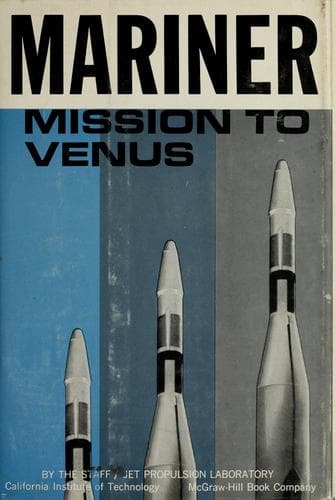
Mariner Mission to VenusJet Propulsion Laboratory (U.S.)
Science
Mariner Mission to Venus
Jet Propulsion Laboratory (U.S.)
Project Mariner (U.S.)
In the Goldstone 1962 experiments, Venus was in effect divided into
observation zones and the doppler effect or change in the returned
signal from these zones was studied. The rate of rotation was derived
from three months of sampling with this radar mapping technique. Also,
the clear, sharp tone characteristic of the transmitted radar signal was
altered on return from Venus into a fuzzy, indistinct sound. This effect
seemed to confirm the slow retrograde rotation (as compared with the
Earth) indicated by the radar mapping and frequency change method.
In addition to these methods of deducing the slow rotation rate, two
other phenomena seemed to verify it: a slowly fluctuating signal
strength, and the apparent progression of a bright radar spot across
from the center of Venus toward the outside edge.
As a result, JPL scientists revised their 1961 estimate of an equal
Venusian day and year consisting of 225 Earth days. The new value for
Venus’ rotation rate around its axis is 230 Earth days plus or minus 40
to 50 days, and in a retrograde direction (opposite to synchronous or
Sun-facing), assuming that Venus rotates on an axis perpendicular to the
plane of its orbit.
Thus, on Venus the Sun would appear to rise in the west and cross to the
east about once each Venusian year. If the period were exactly 225 days
retrograde, the stars would remain stationary in the sky and Venus would
always face a given star rather than the Sun.
A space traveller hovering several million miles directly above the Sun
would thus see Venus as almost stopped in its rotation and possibly
turning very slowly clockwise. All the other planets of our system
including the Earth, rotate counterclockwise, except Uranus, whose axis
is almost parallel to the plane of its orbit, making it seem to roll
around the Sun on its side. The rotation direction of distant Pluto is
unknown.
The Goldstone experiments also studied what is known as the Faraday
rotation of the plane of polarization of a radio wave. The results
indicated that the ionization and magnetic field around Venus are very
low. These data tend to confirm those gathered by Mariner’s experiments
close to the planet.
The mass of Venus was another value that had never been precisely
established. The mass of planetary bodies is determined by their
gravitational effect on other bodies, such as satellites. Since Venus
has no known natural satellite or moon, Mariner, approaching closely
enough to “feel” its gravity, would provide the first opportunity for
close measurement.
The distortion caused by Venus on Mariner’s trajectory as the spacecraft
passed the planet enabled scientists to calculate the mass with an error
probability of 0.015%. The value arrived at is 0.81485 of the mass of
the Earth, which is known to be approximately 13.173 septillion
(13,173,000,000,000,000,000,000,000) pounds. Thus, the mass of Venus is
approximately 10.729 septillion (10,729,408,500,000,000,000,000,000)
pounds.
Public-domain text, read in full here on John Shaqi.
Reviews
Reviews
No reviews yet
Be the first to share your thoughts on this work.
Join the Discussion
Join the discussion
Sign in to leave a comment or review.
Sign InorCreate an account