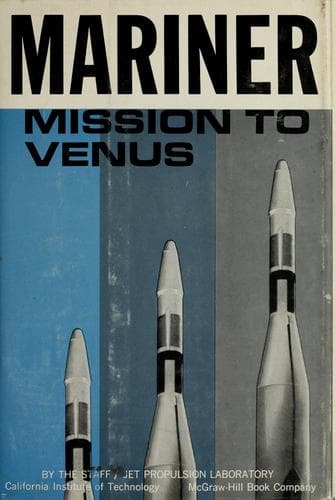
Mariner Mission to VenusJet Propulsion Laboratory (U.S.)
Science
Mariner Mission to Venus
Jet Propulsion Laboratory (U.S.)
Project Mariner (U.S.)
—The clouds of Venus are about 15 miles thick, extending from a base 45
miles above the surface to a top altitude of about 60 miles.
—At the resolution of the Mariner II infrared radiometer, there were no
apparent breaks in the cloud cover. Cloud-top temperature readings are
about minus 30 degrees F near the center (along the terminator), and
ranging down to minus 60 degrees to minus 70 degrees F at the limbs,
showing an apparent limb-darkening effect, which would indicate a hot
surface and the absence of a supercharged ionosphere.
—A spot 20 degrees F colder than the surrounding area exists along the
terminator in the southern hemisphere: a high mountain could exist in
this region, but such an hypothesis is purely conjectural. A bright
radar reflection is also found on the Equator in the same general
region. Causes of these phenomena are not established.
—At their base, the clouds are about 200 degrees F and probably are
comprised of condensed hydrocarbons held in oily suspension. Below the
clouds, the atmosphere must be heavily charged with carbon dioxide,
may contain slight traces of oxygen, and probably has a strong
concentration of nitrogen.
—112
—As determined by the microwave radiometer, Venus’ surface temperature
averages approximately 800 degrees F on both light and dark sides of
the planet. Some roughness is indicated and the surface reflectivity
is equivalent to that of dust and sand. No water could be present at
the surface but there is some possibility of small lakes of molten
metal of one type or another.
—Some reddish sunlight, in the filterable infrared spectrum, may find
its way through the 15-mile-thick cloud cover, but the surface is
probably very bleak.
—The heavy, dense atmosphere creates a surface pressure of some twenty
times that found on the Earth, or equal to about 600 inches of
mercury.
The mission was completed and the spacecraft had gone into an endless
orbit around the Sun. But before Mariner II lost its sing-song voice, it
produced 13 million data words of computer space lyrics to accompany the
music of the spheres.
APPENDIX
SUBCONTRACTORS
Thirty-four subcontractors to JPL provided instruments and other
hardware for Mariners I and II.
The subcontractors were:
Public-domain text, read in full here on John Shaqi.
Reviews
Reviews
No reviews yet
Be the first to share your thoughts on this work.
Elsewhere in the archive
Join the Discussion
Join the discussion
Sign in to leave a comment or review.
Sign InorCreate an account