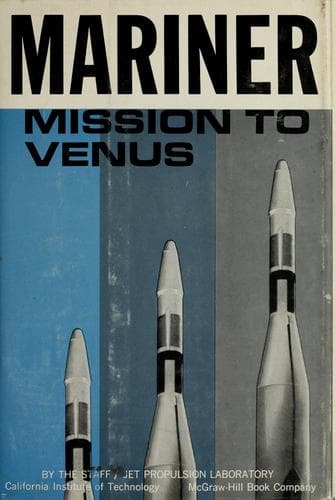
Mariner Mission to VenusJet Propulsion Laboratory (U.S.)
Science
Mariner Mission to Venus
Jet Propulsion Laboratory (U.S.)
Project Mariner (U.S.)
In addition to these measurements, the extremely precise tracking system
used on Mariner proved the feasibility of long-range tracking in space,
particularly in radial velocity, which was measured to within 1/10 of an
inch per second at a distance of about 54 million miles.
As the mission progressed, the trajectory was corrected with respect to
Venus to within 10 miles at encounter. An interesting result was the
very precise location of the Goldstone and overseas tracking stations of
the DSIF. Before Mariner II, these locations were known to within 100
yards. After all the data have been analyzed, these locations will be
redefined or “relocated” to within an error of only 20 yards.
Mariner not only made the first successful journey to Venus—it also
helped pinpoint spots in the Californian and Australian deserts and the
South African veldt with an accuracy never before achieved.
CHAPTER 10
THE NEW LOOK OF VENUS
The historic mission of Mariner II to the near-vicinity of Venus and
beyond has enabled scientists to revise many of their concepts of
interplanetary space and the planet Venus.
The composite picture, taken from the six experiments aboard the
spacecraft and the data from the DSIF radar experiments of 1961 and 1962
revealed the following:
—Interplanetary space between the Earth and Venus, at least as it was
during the four months of Mariner’s mission, had a cosmic dust density
some ten-thousand times lower than the region immediately surrounding
the Earth.
—During this period, the extremely tenuous, widely fluctuating solar
winds streamed continually out from the Sun, at velocities ranging
from 200 to 500 miles per second.
—An astronaut travelling through these regions in the last quarter of
1962 would not have been seriously affected by the cosmic and
high-energy radiation from space and the Sun. He could easily have
survived many times the amount of radiation detected by Mariner’s
instruments.
—111
—The astronomical unit, as determined by radar, the yardstick of our
solar system, stands at 92,956,200, plus or minus 300 miles.
—The mass of Venus in relation to the Earth’s is 0.81485, with an error
probability of 0.015%.
—The rotation rate of Venus is quite slow and is now estimated as equal
to 230 Earth days, plus or minus 40 to 50 days. The rotation might be
retrograde, clockwise with respect to a Sun-facing reference, with the
Sun rising in the west and setting in the east approximately one
Venusian year later. The planet seems to remain nearly star-fixed
rather than permanently oriented with one face to the Sun.
—Venus has no magnetic field discernible at the 21,598-mile approach of
Mariner II and at that altitude there were no regions of trapped
high-energy particles or radiation belts, as there are near the Earth.
Public-domain text, read in full here on John Shaqi.
Reviews
Reviews
No reviews yet
Be the first to share your thoughts on this work.
Elsewhere in the archive
Join the Discussion
Join the discussion
Sign in to leave a comment or review.
Sign InorCreate an account