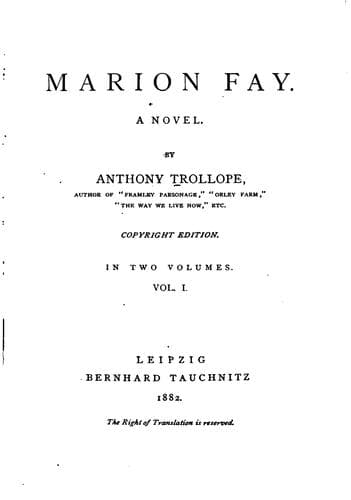
England -- Fiction; Love stories; Male friendship -- Fiction; Quakers -- Fiction; Social classes -- Fiction
He was now old, turned seventy, tall and thin, with long grey hair,
with a slight stoop in his shoulders,--but otherwise hale as well
as healthy. He went every day to his office, leaving his house with
strict punctuality at half-past eight, and entering the door of the
counting-house just as the clock struck nine. With equal accuracy he
returned home at six, having dined in the middle of the day at an
eating-house in the City. All this time was devoted to the interests
of the firm, except for three hours on Thursday, during which he
attended a meeting in a Quaker house of worship. On these occasions
Marion always joined him, making a journey into the City for the
purpose. She would fain have induced him also to accompany her on
Sundays to the English Church. But to this he never would consent
at her instance,--as he had refused to do so at the instance of his
wife. He was he said a Quaker, and did not mean to be aught else
than a Quaker. In truth, though he was very punctual at those Quaker
meetings, he was not at heart a religious man. To go through certain
formularies, Quaker though he was, was as sufficient to him as to
many other votaries of Church ordinances. He had been brought up to
attend Quaker meetings, and no doubt would continue to attend them
as long as his strength might suffice; but it may be presumed of him
without harsh judgment that the price of stocks was often present
to his mind during those tedious hours in the meeting-house. In
his language he always complied with the strict tenets of his sect,
"thou-ing" and "thee-ing" all those whom he addressed; but he had
assented to an omission in this matter on the part of his daughter,
recognizing the fact that there could be no falsehood in using a mode
of language common to all the world. "If a plural pronoun of ignoble
sound," so he said, "were used commonly for the singular because the
singular was too grand and authoritative for ordinary use, it was no
doubt a pity that the language should be so injured; but there could
be no untruth in such usage; and it was better that at any rate the
young should adhere to the manner of speech which was common among
those with whom they lived." Thus Marion was saved from the "thees"
and the "thous," and escaped that touch of hypocrisy which seems to
permeate the now antiquated speeches of Quakers. Zachary Fay in these
latter years of his life was never known to laugh or to joke; but, if
circumstances were favourable, he would sometimes fall into a quaint
mode of conversation in which there was something of drollery and
something also of sarcasm; but this was unfrequent, as Zachary was
slow in making new friends, and never conversed after this fashion
with the mere acquaintance of the hour.
Public-domain text, read in full here on John Shaqi.
Reviews
Reviews
No reviews yet
Be the first to share your thoughts on this work.
Elsewhere in the archive
Join the Discussion
Join the discussion
Sign in to leave a comment or review.
Sign InorCreate an account