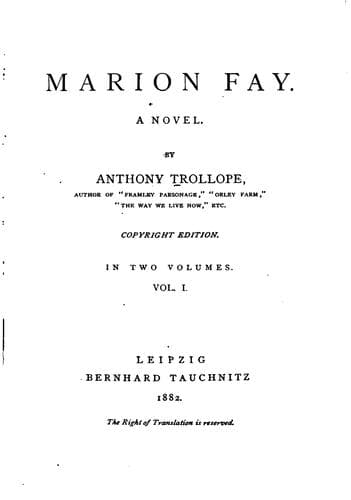
England -- Fiction; Love stories; Male friendship -- Fiction; Quakers -- Fiction; Social classes -- Fiction
"Yes, indeed. Have you not often heard that young men may be
infatuated? It has chanced that I have been the Cinderella for his
eyes."
"But thou art no princess, child."
"And, therefore, am unfit to mate with this prince. I could not
answer him at once, father. It was too sudden for me to find the
words. And the place was hardly fitting. But I have found them now."
"What words, my child?"
"I will tell him with all respect and deference,--nay, I will tell
him with some love, for I do love him,--that it will become him to
look for his wife elsewhere."
"Marion," said the Quaker, who was somewhat moved by those things
which had altogether failed with the girl herself; "Marion, must it
be so?"
"Father, it must certainly be so."
"And yet thou lovest him?"
"Though I were dying for his love it must be so."
"Why, my child, why? As far as I saw the young man he is good and
gracious, of great promise, and like to be true-hearted."
"Good, and gracious, and true-hearted! Oh, yes! And would you have
it that I should bring such a one as that to sorrow,--perhaps to
disgrace?"
"Why to sorrow? Why to disgrace? Wouldst thou be more likely to
disgrace a husband than one of those painted Jezebels who know no
worship but that of their faded beauty? Thou hast not answered him,
Marion?"
"No, father. He is to come on Friday for my answer."
"Think of it yet again, my child. Three days are no time for
considering a matter of such moment. Bid him leave you for ten days
further."
"I am ready now," said Marion.
"And yet thou lovest him! That is not true to nature, Marion. I would
not bid thee take a man's hand because he is rich and great if thou
couldst not give him thy heart in return. I would not have thee break
any law of God or man for the glitter of gold or tinsel of rank. But
the good things of this world, if they be come by honestly, are good.
And the love of an honest man, if thou lovest him thyself in return,
is not of the less worth because he stands high in wealth and in
honour."
"Shall I think nothing of him, father?"
"Yea, verily; it will be thy duty to think of him, almost exclusively
of him,--when thou shalt be his wife."
"Then, father, shall I never think of him."
"Wilt thou pay no heed to my words, so as to crave from him further
time for thought?"
"Not a moment. Father, you must not be angry with your child for
this. My own feelings tell me true. My own heart, and my own
heart alone, can dictate to me what I shall say to him. There are
reasons--"
"What reasons?"
"There are reasons why my mother's daughter should not marry this
man." Then there came a cloud across his brow, and he looked at her
as though almost overcome by his anger. It seemed as though he strove
to speak; but he sat for a while in silence. Then rising from his
chair he left the room, and did not see her again that night.
Public-domain text, read in full here on John Shaqi.
Reviews
Reviews
No reviews yet
Be the first to share your thoughts on this work.
Elsewhere in the archive
Join the Discussion
Join the discussion
Sign in to leave a comment or review.
Sign InorCreate an account