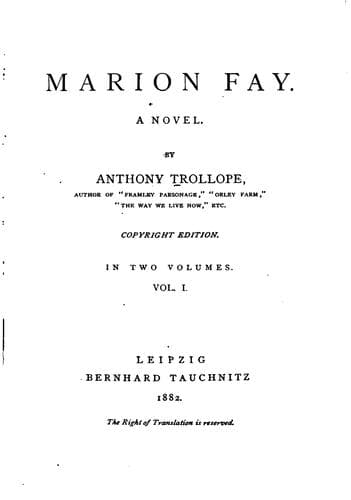
England -- Fiction; Love stories; Male friendship -- Fiction; Quakers -- Fiction; Social classes -- Fiction
As this was the day immediately following Christmas, there was no
business for him in the City. In order that the weary holiday might
be quicker consumed, they breakfasted at No. 17 an hour later than
was usual. After breakfast he got through the morning as well as he
could with his newspaper, and some record of stocks and prices which
he had brought with him from the City. So he remained, fretful, doing
nothing, pretending to read, but with his mind fixed upon the one
subject, till it was twelve o'clock, at which hour he had determined
to make his visit. At half-past one they were to dine, each of them
having calculated, without, however, a word having been spoken, that
Lord Hampstead would certainly not come till the ceremony of dinner
would be over. Though the matter was so vitally important to both of
them, not a word concerning it was spoken.
At twelve o'clock he took up his hat, and walked out. "You will be
back punctually for dinner, father?" she asked. He made his promise
simply by nodding his head, and then left the room. Five minutes
afterwards he was closeted with Mrs. Roden in her drawing-room.
Having conceived the difficulty of leading up to the subject
gradually, he broke into it at once. "Marion has told thee that this
young man will be here to-day?" She simply assented. "Hast thou
advised her as to what she should say?"
"She has not seemed to want advice."
"How should a girl not want advice in so great a matter?"
"How, indeed? But yet she has needed none."
"Has she told thee," he asked, "what it is in her mind to do?"
"I think so."
"Has she said that she would refuse the man?"
"Yes; that certainly was her purpose."
"And given the reasons?" he said, almost trembling as he asked the
question.
"Yes, she gave her reasons."
"And didst thou agree with her?" Before she could reply to this Mrs.
Roden felt herself compelled to pause. When she thought of that one
strongest reason, fully as she agreed with it, she was unable to
tell the father of the girl that she did so. She sat looking at him,
wanting words with which she might express her full concurrence with
Marion without plunging a dagger into the other's heart. "Then thou
didst agree with her?" There was something terrible in the intensity
and slowness of the words as he repeated the question.
"On the whole I did," she said. "I think that unequal marriages are
rarely happy."
"That was all?" he asked. Then when she was again silent, he made
the demand which was so important to him. "Did she say aught of her
health in discussing all this with thee?"
"She did, Mr. Fay."
"And thou?"
"It was a subject, my friend, on which I could not speak to her. All
that was said came from her. Her mind was so fully made up, as I have
said before, no advice from me could avail anything. With some people
it is easy to see that whether you agree with them or differ from
them it is impossible to turn them."
Public-domain text, read in full here on John Shaqi.
Reviews
Reviews
No reviews yet
Be the first to share your thoughts on this work.
Elsewhere in the archive
Join the Discussion
Join the discussion
Sign in to leave a comment or review.
Sign InorCreate an account