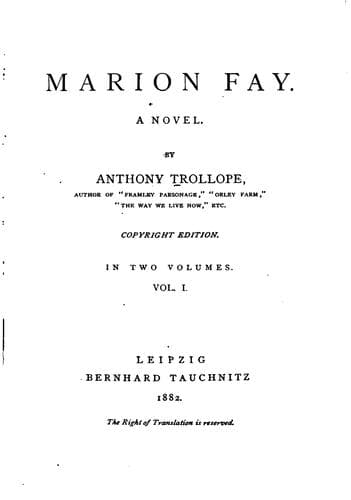
England -- Fiction; Love stories; Male friendship -- Fiction; Quakers -- Fiction; Social classes -- Fiction
"He will take my child away from me. She will then be but little to
me. What want I with lords, who for the few days of active life that
are left to me would not change my City stool for any seat that any
lord can give me? But I shall know that she has had her chance in the
world, and has not been unnecessarily doomed--to an early grave!"
"What would you have me do?"
"Go to her, and tell her that she should look forward, with trust in
God, to such a state of health as He may vouchsafe to give her. Her
thoughts are mostly with her God. Bid her not shorten His mercies.
Bid her not to tell herself that she can examine His purposes. Bid
her do in this as her nature bids her, and, if she can love this man,
give herself into his arms and leave the rest to the Lord."
"But he will be there at once."
"If he be there, what harm? Thou canst go when he comes to the door.
I shall go to her now, and we shall dine together, and then at once I
will leave her. When you see me pass the window then thou canst take
thine occasion." So saying, without waiting for a promise, he left
her and went back to his own house.
And Marion's heart had been full of many thoughts that morning,--some
of them so trifling in their object, that she herself would wonder
at herself because that they should occupy her. How should she be
dressed to receive her lover? In what words first should she speak to
him,--and in what sort? Should she let any sign of love escape from
her? Her resolution as to her great purpose was so fixed that there
was no need for further thought on that matter. It was on the little
things that she was intent. How far might she indulge herself in
allowing some tenderness to escape her? How best might she save him
from any great pain, and yet show him that she was proud that he had
loved her? In what dress she might receive him, in that would she sit
at table with her father. It was Christmas time, and the occasion
would justify whatever of feminine smartness her wardrobe possessed.
As she brought out from its recess the rich silk frock, still all
but new, in which he had first seen her, she told herself that she
would probably have worn it for her father's sake, had no lover been
coming. On the day before, the Christmas Day, she had worn it at
church. And the shoes with the pretty buckles, and the sober but yet
handsome morsel of lace which was made for her throat,--and which she
had not been ashamed to wear at that memorable dinner,--they were
all brought out. It was Christmas, and her father's presence would
surely have justified them all! And would she not wish to leave in
her lover's eyes the memory of whatever prettiness she might have
possessed? They were all produced. But when the moment came for
arraying herself they were all restored to their homes. She would be
the simple Quaker girl as she was to be found there on Monday, on
Tuesday, and on Wednesday. It would be better that he should know how
little there was for him to lose.
Public-domain text, read in full here on John Shaqi.
Reviews
Reviews
No reviews yet
Be the first to share your thoughts on this work.
Elsewhere in the archive
Join the Discussion
Join the discussion
Sign in to leave a comment or review.
Sign InorCreate an account