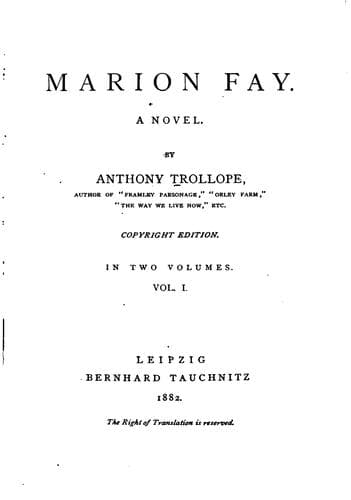
England -- Fiction; Love stories; Male friendship -- Fiction; Quakers -- Fiction; Social classes -- Fiction
Are you not aware, did you not see at the moment, that when you first
knelt at my feet, my heart had flown to you without an effort on my
part to arrest it? But now, my beloved one, now we understand each
other. Now there need be no reproaches between us. Now there need be
no speaking of distrust. I am all yours,--only it is not fit, as you
know, dearest, that the poor Quaker girl should become your wife. Now
that we both understand that, why should we be sad? Why should we
mourn?" Why should she not succeed in bringing things to such a pass
as this; and if so, why should life be unhappy either to him or to
her?
Thus she was thinking of it till she had almost brought herself to a
state of bliss, when her father returned to her. "Father," she said,
getting up and embracing his arm as he stood, "it is all over."
"What is over?" asked the Quaker.
"He has been here."
"Well, Marion; and what has he said?"
"What he said it is hardly for me to tell you. What I said,--I would
you could know it all without my repeating a word of it."
"Has he gone away contented?"
"Nay, not that, father. I hardly expected that. I hardly hoped for
that. Had he been quite contented perhaps I might not have been so."
"Why should you not have both been made happy?" asked the father.
"It may be that we shall be so. It may be that he shall understand."
"Thou hast not taken his offer then?"
"Oh, no! No, father, no. I can never accept his offer. If that be in
your mind put it forth. You shall never see your Marion the wife of
any man, whether of that young lord or of another more fitted to her.
No one ever shall be allowed to speak to me as he has spoken."
"Why dost thou make thyself different from other girls?" he said,
angrily.
"Oh, father, father!"
"It is romance and false sentiment, than which nothing is more odious
to me. There is no reason why thou shouldst be different from others.
The Lord has not marked thee out as different from other girls,
either in His pleasure or His displeasure. It is wrong for thee to
think it of thyself." She looked up piteously into his face, but said
not a word. "It is thy duty to take thyself from His hands as He has
made thee; and to give way to no vain ecstatic terrors. If, as I
gather from thy words, this young man be dear to thee, and if, as I
gather from this second coming of his, thou art dear to him, then I
as thy father tell thee that thy duty calls thee to him. It is not
that he is a lord."
"Oh, no, father."
Public-domain text, read in full here on John Shaqi.
Reviews
Reviews
No reviews yet
Be the first to share your thoughts on this work.
Elsewhere in the archive
Join the Discussion
Join the discussion
Sign in to leave a comment or review.
Sign InorCreate an account