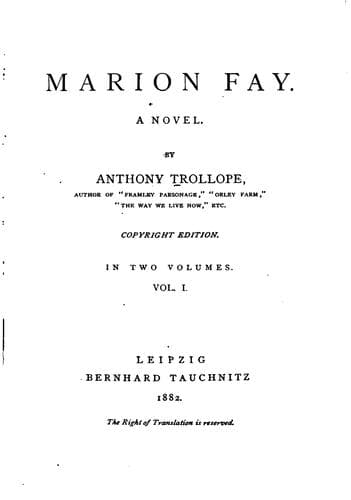
England -- Fiction; Love stories; Male friendship -- Fiction; Quakers -- Fiction; Social classes -- Fiction
It must be explained that Crocker had lately made the acquaintance
of Miss Clara Demijohn without any very formal introduction. Crocker,
with that determination which marked his character, in pursuit of the
one present purport of his mind to effect a friendly reconciliation
with George Roden, had taken himself down to Holloway, and had called
at No. 11, thinking that he might induce his friend's mother to act
on his behalf in a matter appertaining to peace and charity. Mrs.
Roden had unhappily been from home, but he had had the good fortune
to encounter Miss Demijohn. Perhaps it was that she had seen him
going in and out of the house, and had associated him with the
great mystery of the young nobleman; perhaps she had been simply
attracted by the easy air with which he cocked his hat and swung his
gloves;--or, perhaps it was simply chance. But so it was that in the
gloom of the evening she met him just round the corner opposite to
the "Duchess of Edinburgh," and the happy acquaintance was commenced.
No doubt, as in all such cases, it was the gentleman who spoke first.
Let us, at any rate, hope so for the sake of Paradise Row generally.
Be that as it may, before many minutes were over she had explained
to him that Mrs. Roden had gone out in a cab soon after dinner, and
that probably something was up at Wimbledon, as Mrs. Roden never
went anywhere else, and this was not the day of the week on which
her visits to Mrs. Vincent were generally made. Crocker, who was
simplicity itself, soon gave her various details as to his own
character and position in life. He, too, was a clerk in the Post
Office, and was George Roden's particular friend. "Oh, yes; he
knew all about Lord Hampstead, and was, he might say, intimately
acquainted with his lordship. He had been in the habit of meeting his
lordship at Castle Hautboy, the seat of his friend, Lord Persiflage,
and had often ridden with his lordship in the hunting-field. He knew
all about Lady Frances and the engagement, and had had the pleasure
of making the acquaintance of her ladyship. He had been corresponding
lately with Lord Hampstead on the subject. No;--he had not as yet
heard anything of Marion Fay, the Quaker's daughter. Then Clara
had something to say on her side. She quite understood that if she
expected to be communicated with, she also must communicate; and
moreover, young Mr. Crocker was by his age, appearance, and sex,
just such a one as prompted her to be communicative without loss of
self-respect. What was the good of telling things to Mrs. Duffer, who
was only an old widow without any friends, and with very small means
of existence? She had communicated her secrets to Mrs. Duffer simply
from want of a better pair of ears into which she could pour them.
But here was one in telling secrets to whom she could take delight,
and who had secrets of his own to give in return. It is not to be
supposed that the friendship which arose grew from the incidents of
one meeting only.
Public-domain text, read in full here on John Shaqi.
Reviews
Reviews
No reviews yet
Be the first to share your thoughts on this work.
Elsewhere in the archive
Join the Discussion
Join the discussion
Sign in to leave a comment or review.
Sign InorCreate an account