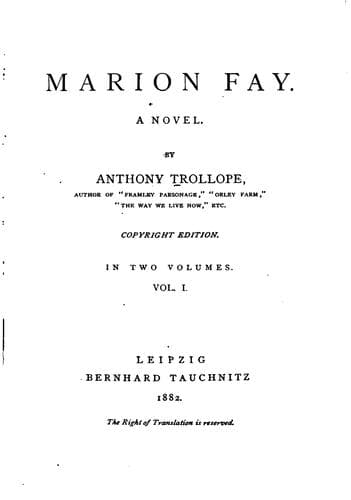
England -- Fiction; Love stories; Male friendship -- Fiction; Quakers -- Fiction; Social classes -- Fiction
When the morning came, and while he was yet in his bed, he struggled
to bethink himself of some strategy by which he might evade the evil
hour. Could he have been sent for suddenly into Cumberland? But in
this case he would of course have telegraphed to the Post Office on
the preceding day. Could he have been taken ill with a fit,--so as
to make his absence absolutely necessary, say for an entire week?
He well knew that they had a doctor at the Post Office, a crafty,
far-seeing, obdurate man, who would be with him at once and would
show him no mercy. He had tried these schemes all round, and had
found that there were none left with which Æolus was not better
acquainted than was he himself. There was nothing for it but to go
and bear the brunt.
Exactly at ten o'clock he entered the room, hung his hat up on the
accustomed peg, and took his seat on the accustomed chair before any
one spoke a word to him. Roden on the opposite seat took no notice of
him. "Bedad, he's here anyhow this morning," whispered Geraghty to
Bobbin, very audibly. "Mr. Crocker," said Mr. Jerningham, "you were
absent throughout the entire day yesterday. Have you any account
to give of yourself?" There was certainly falsehood implied in
this question, as Mr. Jerningham knew very well what had become of
Crocker. Crocker's misadventure at the police office had found its
way into the newspapers, and had been discussed by Æolus with Mr.
Jerningham. I am afraid that Mr. Jerningham must have intended to
tempt the culprit into some false excuse.
"I was horribly ill," said Crocker, without stopping the pen with
which he was making entries in the big book before him. This no doubt
was true, and so far the trap had been avoided.
"What made you ill, Mr. Crocker?"
"Headache."
"It seems to me, Mr. Crocker, you're more subject to such attacks as
these than any young man in the office."
"I always was as a baby," said Crocker, resuming something of his
courage. Could it be possible that Æolus should not have heard of the
day's absence?
"There is ill-health of so aggravated a nature," said Mr. Jerningham,
"as to make the sufferer altogether unfit for the Civil Service."
"I'm happy to say I'm growing out of them gradually," said Crocker.
Then Geraghty got up from his chair and whispered the whole truth
into the sufferer's ears. "It was all in the _Pall Mall_ yesterday,
and Æolus knew it before he went away." A sick qualm came upon the
poor fellow as though it were a repetition of yesterday's sufferings.
But still it was necessary that he should say something. "New Year's
Day comes only once a year, I suppose."
"It was only a few weeks since that you remained a day behind your
time when you were on leave. But Sir Boreas has taken the matter up,
and I have nothing to say to it. No doubt Sir Boreas will send for
you." Sir Boreas Bodkin was that great Civil servant in the General
Post Office whom men were wont to call Æolus.
Public-domain text, read in full here on John Shaqi.
Reviews
Reviews
No reviews yet
Be the first to share your thoughts on this work.
Elsewhere in the archive
Join the Discussion
Join the discussion
Sign in to leave a comment or review.
Sign InorCreate an account