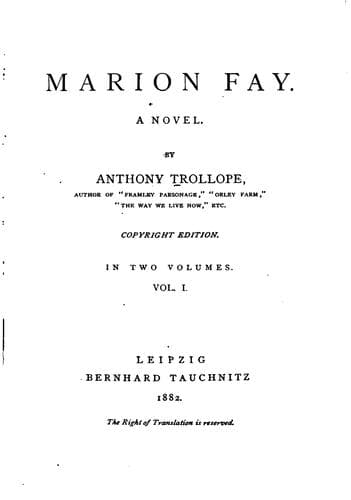
England -- Fiction; Love stories; Male friendship -- Fiction; Quakers -- Fiction; Social classes -- Fiction
Mr. Greenwood was still anxious as to the health of the Rector
of Appleslocombe. There might be even yet a hope for him;
but his chance, he thought, would be better with the present
Marquis--ill-disposed towards him as the Marquis was--than with
the heir. The Marquis was weary of him, and anxious to get rid of
him,--was acting very meanly to him, as Mr. Greenwood thought, having
offered him £1000 as a final payment for a whole life's attention.
The Marquis, who had ever been a liberal man, had now, perhaps on
his death-bed, become unjust, harsh, and cruel. But he was weak and
forgetful, and might possibly be willing to save his money and get
rid of the nuisance of the whole affair by surrendering the living.
This was Mr. Greenwood's reading of the circumstances as they at
present existed. But the Marquis could not dispose of the living
while the Rector was still alive; nor could he even promise it,
to any good effect, without his son's assent. That Lord Hampstead
would neither himself so bestow his patronage or allow it to be so
bestowed, Mr. Greenwood was very sure. There had been that between
him and Lord Hampstead which convinced him that the young man
was more hostile to him even than the father. The Marquis, as Mr.
Greenwood thought, had insulted him of late;--but Lord Hampstead,
young as he was, had also been insolent; and what was worse, he had
insulted Lord Hampstead. There had been something in the young lord's
eye which had assured him of the young lord's contempt as well as
dislike. If anything could be done about the living it must be done
by the Marquis. The Marquis was very ill; but it was still probable
that the old rector should die first. He had been given to understand
that the old rector could hardly live many weeks.
Mr. Greenwood understood but little of the young lord's character.
The Marquis, no doubt, he knew well, having lived with him for
many years. When he supposed his patron to be fretful and irascible
because of his infirmities, but to be by nature forgiving,
unreasonable, and weak, he drew an easy portrait, which was like the
person portrayed. But in attributing revenge, or harshness, or pride
of power to Lord Hampstead he was altogether wrong. As regarded
Appleslocombe and other parishes, the patronage of which would some
day belong to him, Lord Hampstead had long since made up his mind
that he would have nothing to do with them, feeling himself unfit to
appoint clergymen to ministrations in a Church to which he did not
consider himself to belong. All that he would leave to the Bishop,
thinking that the Bishop must know more about it than himself. Was
his father, however, to make any request to him with reference to
Appleslocombe especially, he would no doubt regard the living as
bestowed before his father's death. But of all this Mr. Greenwood
could understand nothing. He felt, however, that as the Marquis had
given him cause for anger, so had the young lord given him cause for
hatred as well as anger.
Public-domain text, read in full here on John Shaqi.
Reviews
Reviews
No reviews yet
Be the first to share your thoughts on this work.
Elsewhere in the archive
Join the Discussion
Join the discussion
Sign in to leave a comment or review.
Sign InorCreate an account