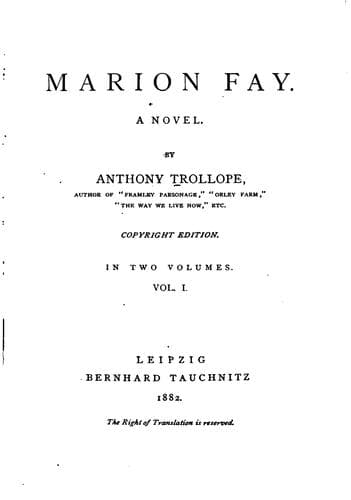
England -- Fiction; Love stories; Male friendship -- Fiction; Quakers -- Fiction; Social classes -- Fiction
As he thought of it his first and prevailing fear did not come from
the ignominious punishment which is attached to, and which generally
attends, the crime. He has been described as a man flabby in
appearance, as one who seemed to tremble in his shoes when called
upon for any special words, as one who might be supposed to be devoid
of strong physical daring. But the true character of the man was
opposed to his outward bearing. Courage is a virtue of too high a
nature to be included among his gifts; but he had that command of his
own nerves, that free action of blood round his heart, that personal
audacity coming from self-confidence, which is often taken to
represent courage. Given the fact that he wanted an enemy out of
the way, he could go to work to prepare to put him out of the way
without exaggerated dread of the consequences as far as this world is
concerned. He trusted much in himself, and thought it possible that
he could so look through all the concomitant incidents of such an
act as that he contemplated without allowing one to escape him which
might lead to detection. He could so look at the matter, he thought,
as to be sure whether this or the other plot might or might not be
safe. It might be that no safe plot were possible, and that the
attempt must therefore be abandoned. These, at any rate, were not the
dangers which made him creep about in dismay at his own intentions.
There were other dangers of which he could not shake off the dread.
Whether he had any clear hope as to eternal bliss in another life,
it may be doubted. He probably drove from his mind thoughts on the
subject, not caring to investigate his own belief. It is the practice
of many to have their minds utterly callous in that respect. To
suppose that such men think this or think the other as to future
rewards and punishments is to give them credit for a condition of
mind to which they have never risen. Such a one was probably Mr.
Greenwood; but nevertheless he feared something when this idea
respecting Lord Hampstead presented itself to him. It was as is some
boggy-bo to a child, some half-belief in a spectre to a nervous
woman, some dread of undefined evil to an imaginative but melancholy
man. He did not think that by meditating such a deed, by hardening
his heart to the necessary resolution, by steeling himself up to its
perpetration, he would bring himself into a condition unfitted for
a life of bliss. His thoughts did not take any such direction. But
though there might be no punishment in this world,--even though there
were to be no other world in which punishment could come,--still
something of evil would surely fall upon him. The convictions of the
world since the days of Cain have all gone in that direction. It was
thus that he allowed himself to be cowed, and to be made to declare
to himself again and again that the project must be abandoned.
Public-domain text, read in full here on John Shaqi.
Reviews
Reviews
No reviews yet
Be the first to share your thoughts on this work.
Elsewhere in the archive