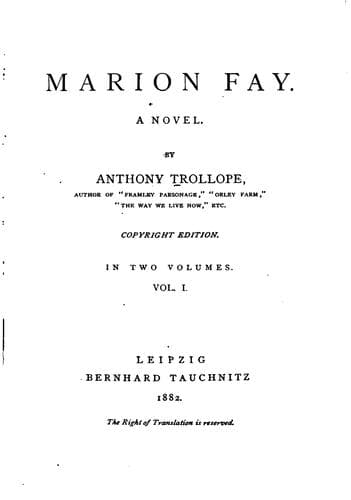
England -- Fiction; Love stories; Male friendship -- Fiction; Quakers -- Fiction; Social classes -- Fiction
Mr. Greenwood, when he was thus left alone, did not at once leave the
room. He had reseated himself, and there he remained still gazing as
though there had been some one for him to gaze at, and still seated
on the edge of his chair as though there were some one to see the
affected humility of his position. But in truth the gazing and the
manner of sitting had become so customary to him that they were
assumed without thought. His mind was now full of the injury done
to him by the Marchioness. She had made him her confidant; she had
poured her secret thoughts into his ears; she had done her best to
inspire him with her hatred and her desires;--and now, when she had
almost taught him to be the minister of her wishes, she turned upon
him, and upbraided him and deserted him! Of course when he had
sympathized with her as to her ill-used darlings he had expected her
to sympathize with him as to the hardships inflicted upon him. But
she cared nothing for his hardships, and was anxious to repudiate the
memory of all the hard words which she had spoken as to her husband's
children. It should not be so! She should not escape from him in this
manner! When confidences have been made, the persons making them must
abide the consequences. When a partnership has been formed, neither
partner has a right to retreat at once, leaving the burden of all
debts upon the other. Had not all these thoughts, and plottings,
which had been so heavy on his mind since that telegram had come,
which had been so heavy on his soul, been her doing? Had not the idea
come from her? Had there not been an unspoken understanding between
them that in consequence of certain mutual troubles and mutual
aspirations there should be a plan of action arranged between them?
Now she was deserting him! Well;--he thought that he could so
contrive things that she should not do so with impunity. Having
considered all this he got up from his chair and slowly walked down
to his own room.
He lunched by himself, and then sat himself down with a novel, as was
his wont at that hour of the day. There could be no man more punctual
in all his daily avocations than Mr. Greenwood. After lunch there
always came the novel; but there was seldom much of it read. He
would generally go to sleep, and would remain so, enjoying perfect
tranquillity for the best part of an hour. Then he would go out for
his constitutional walk, after which he would again take up the
novel till the time came for her ladyship's tea. On this occasion
he did not read at all, but neither did he at once sleep. There had
been that on his mind which, even though it had not been perfected,
banished sleep from him for some minutes. There was no need of any
further conversation as to safety or danger. The deed, whether it
would or could not have been done in the manner he had premeditated,
certainly would not be done now. Certainly not now would he file his
mind for Banquo's issue. But after half-an-hour of silent meditation
he did sleep.
Public-domain text, read in full here on John Shaqi.
Reviews
Reviews
No reviews yet
Be the first to share your thoughts on this work.
Elsewhere in the archive
Join the Discussion
Join the discussion
Sign in to leave a comment or review.
Sign InorCreate an account