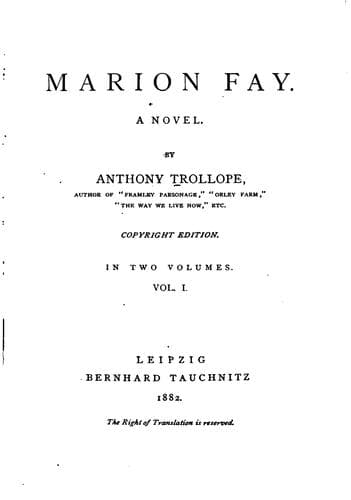
England -- Fiction; Love stories; Male friendship -- Fiction; Quakers -- Fiction; Social classes -- Fiction
He found no trouble in making his way into her presence. She had
heard of his visit to King's Court, and knew that he would come. She
had three things which she had to tell him, and she would tell them
all very plainly if all should be necessary. The first was that love
must have nothing to do in this matter,--but only duty. The second,
which she feared to be somewhat weak,--which she almost thought would
not of itself have been strong enough,--was that objection as to her
condition in life which she had urged to him before. She declared to
herself that it would be strong enough both for him, and for her, if
they would only guide themselves by prudence. But the third,--that
should be a rock to her if it were necessary; a cruel rock on which
she must be shipwrecked, but against which his bark should surely not
be dashed to atoms. If he would not leave her in peace without it she
would tell him that she was fit to be no man's wife.
If it came to that, then she must confess her own love. She
acknowledged to herself that it must be so. There could not be
between them the tenderness necessary for the telling of such a
tale without love, without acknowledged love. It would be better
that it should not be so. If he would go and leave her to dream of
him,--there might be a satisfaction even in that to sustain her
during what was left to her of life. She would struggle that it
should be so. But if his love were too strong, then must he know it
all. She had learned from her father something of what had passed at
that interview in the City, and was therefore ready to receive her
lover when he came. "Marion," he said, "you expected me to come to
you again?"
"Certainly I did."
"Of course I have come. I have had to go to my father, or I should
have been here sooner. You know that I shall come again and again
till you will say a word to me that shall comfort me."
"I knew that you would come again, because you were with father in
the City."
"I went to ask his leave,--and I got it."
"It was hardly necessary for you, my lord, to take that trouble."
"But I thought it was. When a man wishes to take a girl away from her
own home, and make her the mistress of his, it is customary that he
shall ask for her father's permission."
"It would have been so, had you looked higher,--as you should have
done."
"It was so in regard to any girl that I should wish to make my wife.
Whatever respect a man can pay to any woman, that is due to my
Marion." She looked at him, and with the glance of her eye went all
the love of her heart. How could she say those words to him, full of
reason and prudence and wisdom, if he spoke to her like this? "Answer
me honestly. Do you not know that if you were the daughter of the
proudest lord living in England you would not be held by me as
deserving other usage than that which I think to be your privilege
now?"
"I only meant that father could not but feel that you were honouring
him."
Public-domain text, read in full here on John Shaqi.
Reviews
Reviews
No reviews yet
Be the first to share your thoughts on this work.
Elsewhere in the archive
Join the Discussion
Join the discussion
Sign in to leave a comment or review.
Sign InorCreate an account