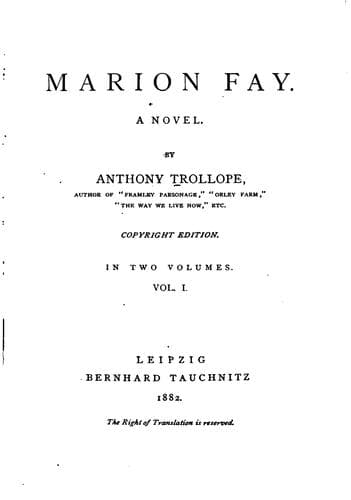
England -- Fiction; Love stories; Male friendship -- Fiction; Quakers -- Fiction; Social classes -- Fiction
Hampstead, when he was turned out into Paradise Row, walked once or
twice up the street, thinking what he might best do next, regardless
of the eyes at No. 10 and No. 15;--knowing that No. 11 was absent,
where alone he could have found assistance had the inhabitant been
there. As far as he could remember he had never seen a woman faint
before. The way in which she had fallen through from his arms on
to the sofa when he had tried to sustain her, had been dreadful to
him; and almost more dreadful the idea that the stout old woman with
whom he had left her should be more powerful than he to help her.
He walked once or twice up and down, thinking what he had best now
do, while Clara Demijohn was lost in wonder as to what could have
happened at No. 17. It was quite intelligible to her that the lover
should come in the father's absence and be entertained,--for a whole
afternoon if it might be so; though she was scandalized by the
audacity of the girl who had required no screen of darkness under
the protection of which her lover's presence might be hidden from
the inquiries of neighbours. All that, however, would have been
intelligible. There is so much honour in having a lord to court
one that perhaps it is well to have him seen. But why was the lord
walking up and down the street with that demented air?
It was now four o'clock, and Hampstead had heard the Quaker say that
he never left his office till five. It would take him nearly an hour
to come down in an omnibus from the City. Nevertheless Hampstead
could not go till he had spoken to Marion's father. There was the
"Duchess of Edinburgh," and he could no doubt find shelter there.
But to get through two hours at the "Duchess of Edinburgh" would, he
thought, be beyond his powers. To consume the time with walking might
be better. He started off, therefore, and tramped along the road
till he came nearly to Finchley, and then back again. It was dark as
he returned, and he fancied that he could wait about without being
perceived. "There he is again," said Clara, who had in the mean time
gone over to Mrs. Duffer. "What can it all mean?"
"It's my belief he's quarrelled with her," said Mrs. Duffer.
"Then he'd never wander about the place in that way. There's old
Zachary just come round the corner. Now we shall see what he does."
"Fainted, has she?" said Zachary, as they walked together up to the
house. "I never knew my girl do that before. Some of them can faint
just as they please; but that's not the way with Marion." Hampstead
protested that there had been no affectation on this occasion; that
Marion had been so ill as to frighten him, and that, though he
had gone out of the house at the woman's bidding, he had found it
impossible to leave the neighbourhood till he should have learnt
something as to her condition. "Thou shalt hear all I can tell thee,
my friend," said the Quaker, as they entered the house together.
Public-domain text, read in full here on John Shaqi.
Reviews
Reviews
No reviews yet
Be the first to share your thoughts on this work.
Elsewhere in the archive
Join the Discussion
Join the discussion
Sign in to leave a comment or review.
Sign InorCreate an account