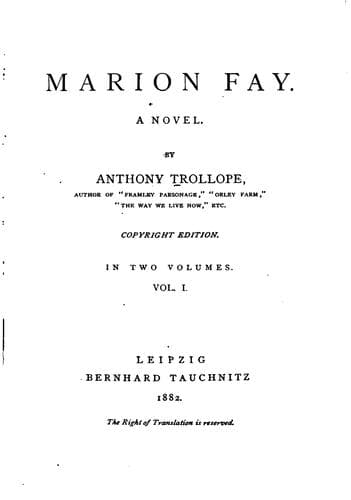
England -- Fiction; Love stories; Male friendship -- Fiction; Quakers -- Fiction; Social classes -- Fiction
"By George, yes; I wish you'd lend him to me. I got my brute in
between two rails, and it took me half-an-hour to smash a way
through. I never saw anything of it after that." Poor Hautboy almost
cried as he gave this account of his own misfortune.
"You were the only fellow I saw try them after Crasher," said Vivian.
"Crasher came on his head, and I should think he must be there still.
I don't know where Hampstead got through."
"I never know where I've been," said Hampstead, who had, in truth,
led the way over the double rails which had so confounded Crasher and
had so perplexed Hautboy. But when a man is too forward to be seen,
he is always supposed to be somewhere behind.
Then there was an opinion expressed by Walker that Tolleyboy, the
huntsman, had on that special occasion stuck very well to his hounds,
to which Watson gave his cordial assent. Walker and Watson had both
been asked to dinner, and during the day had been heard to express
to each other all that adverse criticism as to the affairs of the
hunt in general which appeared a few lines back. Walker and Watson
were very good fellows, popular in the hunt, and of all men the most
unlikely to give it up.
When that run was talked about afterwards, as it often was, it was
always admitted that Lord Llwddythlw had been the hero of the day.
But no one ever heard him talk of it. Such a trifle was altogether
beneath his notice.
CHAPTER XVIII.
POOR WALKER.
That famous run took place towards the end of February, at which time
Hampstead was counting all the hours till he should again be allowed
to show himself in Paradise Row. He had in the mean time written one
little letter to the Quaker's daughter;--
DEAREST MARION,--I only write because I cannot keep myself
quiet without telling you how well I love you. Pray do not
believe that because I am away I think of you less. I am
to see you, I hope, on Monday, the 2nd of March. If you
would write me but one word to say that you will be glad
to see me!
Always your own,
H.
She showed this to her father, and the sly old Quaker told her that
it would not be courteous in her not to send some word of reply. As
the young lord, he said, had been permitted by him, her father, to
pay his addresses to her, so much was due to him. Why should his girl
lose this grand match? Why should his daughter not become a happy and
a glorious wife, seeing that her beauty and her grace had entirely
won this young lord's heart? "MY LORD," she wrote back to him,--"I
shall be happy to see you when you come, whatever day may suit you.
But, alas! I can only say what I have said.--Yet I am thine, MARION."
She had intended not to be tender, and yet she had thought herself
bound to tell him that all that she had said before was true.
Public-domain text, read in full here on John Shaqi.
Reviews
Reviews
No reviews yet
Be the first to share your thoughts on this work.
Elsewhere in the archive
Join the Discussion
Join the discussion
Sign in to leave a comment or review.
Sign InorCreate an account