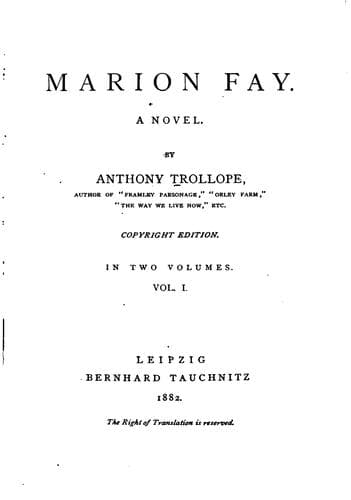
England -- Fiction; Love stories; Male friendship -- Fiction; Quakers -- Fiction; Social classes -- Fiction
to make her believe at any rate the truth of this last statement.
It was not that she ceased to love him, but that she knew that he
was not fit to be loved. When a woman is bad a man can generally get
quit of her from his heartstrings;--but a woman has no such remedy.
She can continue to love the dishonoured one without dishonour to
herself,--and does so.
Among other misfortunes was the loss of all her money. There she was,
in the little villa on the side of the lake, with no income,--and
with statements floating about her that she had not, and never had
had, a husband. It might well be that after that she should caution
Marion Fay as to the imprudence of an exalted marriage. But there
came to her assistance, if not friendship and love, in the midst
of her misfortunes. Her brother-in-law,--if she had a husband or
a brother-in-law,--came to her from the old Duke with terms of
surrender; and there came also a man of business, a lawyer, from
Venice, to make good the terms if they should be accepted. Though
money was very scarce with the family, or the power of raising money,
still such was the feeling of the old nobleman in her misfortunes
that the entire sum which had been given up to his eldest son should
be restored to trustees for her use and for the benefit of her baby,
on condition that she should leave Italy, and consent to drop the
title of the Di Crinola family. As to that question of a former
marriage, the old lawyer declared that he was unable to give any
certain information. The reprobate had no doubt gone through some
form of a ceremony with a girl of low birth at Venice. It very
probably was not a marriage. The young Duchino, the brother, declared
his belief that there had been no such marriage. But she, should
she cling to the name, could not make her title good to it without
obtaining proofs which they had not been able to find. No doubt
she could call herself Duchess. Had she means at command she might
probably cause herself to be received as such. But no property would
thus be affected,--nor would it rob him, the younger son, of his
right to call himself also by the title. The offer made to her was
not ungenerous. The family owed her nothing, but were willing to
sacrifice nearly half of all they had with the object of restoring
to her the money of which the profligate had robbed her,--which he
had been enabled to take from her by her own folly and credulity. In
this terrible emergency of her life, Mrs. Vincent sent over to her a
solicitor from London, between whom and the Italian man of business
a bargain was struck. The young wife undertook to drop her husband's
name, and to drop it also on behalf of her boy. Then the eight
thousand pounds was repaid, and Mrs. Roden, as she afterwards called
herself, went back to Wimbledon and to England with her baby.
Public-domain text, read in full here on John Shaqi.
Reviews
Reviews
No reviews yet
Be the first to share your thoughts on this work.
Elsewhere in the archive
Join the Discussion
Join the discussion
Sign in to leave a comment or review.
Sign InorCreate an account