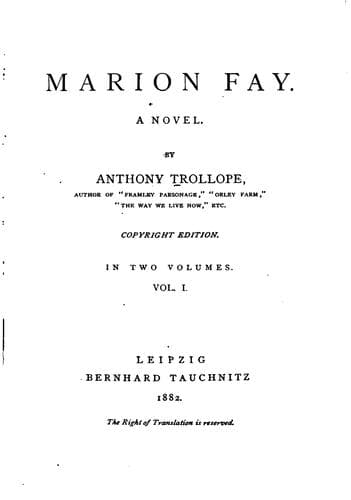
England -- Fiction; Love stories; Male friendship -- Fiction; Quakers -- Fiction; Social classes -- Fiction
George Roden had hitherto learnt nothing of his father or his family.
In the many consultations held between his mother and Mrs. Vincent
it had been decided that it would be better to keep him in the dark.
Why fill his young imagination with the glory of a great title in
order that he might learn at last, as might too probably be the case,
that he had no right to the name,--no right to consider himself
even to be his father's son? She, by her folly,--so she herself
acknowledged,--had done all that was possible to annihilate herself
as a woman. There was no name which she could give to her son as
certainly as her own. This, which had been hers before she had been
allured into a mock marriage, would at any rate not be disputed. And
thus he had been kept in ignorance of his mother's story. Of course
he had asked. It was no more than natural that he should ask. But
when told that it was for his mother's comfort that he should ask no
more, he had assented with that reticence which was peculiar to him.
Then chance had thrown him into friendship with the young English
nobleman, and the love of Lady Frances Trafford had followed.
His mother, when he consented to accompany her, had almost promised
him that all mysteries should be cleared up between them before their
return. In the train, before they reached Paris, a question was
asked and an answer given which served to tell much of the truth. As
they came down to breakfast that morning, early in the dark January
morning, he observed that his mother was dressed in deep mourning.
It had always been her custom to wear black raiment. He could not
remember that he had ever seen on her a coloured dress, or even
a bright ribbon. And she was not now dressed quite as is a widow
immediately on the death of her husband. It was now a quarter of a
century since she had seen the man who had so ill-used her. According
to the account which she had received, it was twelve months at least
since he had died in one of the Grecian islands. The full weeds of a
mourning widow would ill have befitted her condition of mind, or her
immediate purpose. But yet there was a speciality of blackness in her
garments which told him that she had dressed herself with a purpose
as of mourning. "Mother," he said to her in the train, "you are in
mourning,--as for a friend?" Then when she paused he asked again,
"May I not be told for whom it is done? Am I not right in saying that
it is so?"
"It is so, George."
"For whom then?"
They two were alone in the carriage, and why should his question not
be answered now? But it had come to pass that there was a horror to
her in mentioning the name of his father to him. "George," she said,
"it is more than twenty-five years since I saw your father."
"Is he dead--only now?"
"It is only now,--only the other day,--that I have heard of his
death."
"Why should not I also be in black?"
Public-domain text, read in full here on John Shaqi.
Reviews
Reviews
No reviews yet
Be the first to share your thoughts on this work.
Elsewhere in the archive
Join the Discussion
Join the discussion
Sign in to leave a comment or review.
Sign InorCreate an account