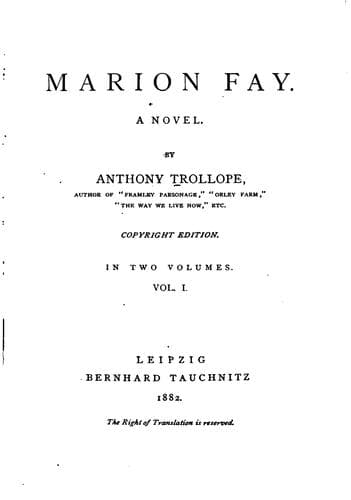
England -- Fiction; Love stories; Male friendship -- Fiction; Quakers -- Fiction; Social classes -- Fiction
Lady Frances was, as may be imagined, much startled at the receipt
of this letter;--startled, and also pleased. Though she had always
declared to herself that she was in every respect satisfied with her
lover from the Post Office, though she had been sure that she had
never wanted him to be other than he was, still, when she heard of
that fine-sounding name, there did for a moment come upon her an
idea that, for his sake, it might be well that he should have the
possession of all that his birth had done for him. But when she came
to understand the meaning of his words, as she did on the second or
third reading of his letter,--when she discovered what he meant by
saying that he hoped she would not think better of him by reason
of what he was telling her, when she understood the purport of the
manner in which he signed his name, she resolved that in every
respect she would think as he thought and act as he wished her to
act. Whatever might be the name which he might be pleased to give
her, with that would she be contented, nor would she be led by any
one belonging to her to ask him to change his purpose.
For two days she kept the letter by her unanswered, and without
speaking of it to anybody. Then she showed it to her brother,
exacting from him a promise that he should not speak of it to any one
without her permission. "It is George's secret," she said, "and I am
sure you will see that I have no right to disclose it. I tell you
because he would do so if he were here." Her brother was willing
enough to make the promise, which would of course be in force only
till he and Roden should see each other; but he could not be brought
to agree with his sister as to his friend's view of the position.
"He may have what fancies he pleases about titles," he said, "as may
I; but I do not think that he would be justified in repudiating his
father's name. I feel it a burden and an absurdity to be born to be
an earl and a marquis, but I have to put up with it; and, though
my reason and political feeling on the matter tell me that it is a
burden and an absurdity, yet the burden is easily borne, and the
absurdity does not annoy me much. There is a gratification in being
honoured by those around you, though your conscience may be twinged
that you yourself have done nothing to deserve it. It will be so with
him if he takes his position here as an Italian nobleman."
"But he would still have to be a clerk in the Post Office."
"Probably not."
"But how would he live?" asked Lady Frances.
"The governor, you would find, would look upon him in a much more
favourable light than he does at present."
"That would be most unreasonable."
"Not at all. It is not unreasonable that a Marquis of Kingsbury
should be unwilling to give his daughter to George Roden, a clerk in
the Post Office,--but that he should be willing to give her to a Duca
di Crinola."
"What has that to do with earning money?"
Public-domain text, read in full here on John Shaqi.
Reviews
Reviews
No reviews yet
Be the first to share your thoughts on this work.
Elsewhere in the archive
Join the Discussion
Join the discussion
Sign in to leave a comment or review.
Sign InorCreate an account