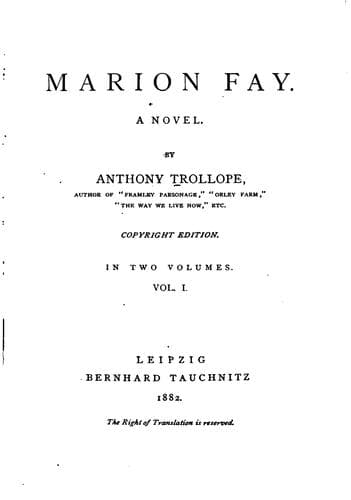
England -- Fiction; Love stories; Male friendship -- Fiction; Quakers -- Fiction; Social classes -- Fiction
Duca di Crinola! She could not quite believe it;--and yet she did
believe it. Nor could she be quite sure as to herself whether she was
happy in believing it or the reverse. It had been terrible to her to
think that she should have to endure the name of being stepmother to
a clerk in the Post Office. It would not be at all terrible to her
to be stepmother to a Duca di Crinola, even though the stepson would
have no property of his own. That little misfortune would, as far as
the feelings of society went, be swallowed up amidst the attributes
of rank. Nothing would sound better than Duchessa or Duchessina!
And, moreover, it would be all true! This was no paltry title which
might be false, or might have been picked up, any how, the other
day. All the world would know that the Italian Duke was the lineal
representative of a magnificent family to whom this identical rank
had belonged for many years. There were strong reasons for taking the
young Duke and the young Duchess to her heart at once.
But then there were other reasons why she should not wish it to be
true. In the first place she hated them both. Let the man be Duca di
Crinola as much as he might, he would still have been a Post Office
clerk, and Lady Frances would have admitted his courtship having
believed him at the time to have been no more than a Post Office
clerk. The sin would have been not the less abominable in the choice
of her lover, although it might be expedient that the sin should be
forgiven. And then the girl had insulted her, and there had been that
between them which would prevent the possibility of future love; and
would it not be hard upon her darlings if it should become necessary
to carve out from the family property a permanent income for this
Italian nobleman, and for a generation of Italian noblemen to come;
and then what a triumph would this be for Hampstead, who, of all
human beings, was the most distasteful to her.
But upon the whole she thought it would be best to accept the Duca.
She must, indeed, accept him. Nothing that she could do would restore
the young man to his humble desk and humble name. Nor would the
Marquis be actuated by any prayer of hers in reference to the carving
of the property. It would be better for her to accept the young Duke
and the young Duchess, and make the best of them. If only the story
should at last be shown to be true!
Public-domain text, read in full here on John Shaqi.
Reviews
Reviews
No reviews yet
Be the first to share your thoughts on this work.
Elsewhere in the archive
Join the Discussion
Join the discussion
Sign in to leave a comment or review.
Sign InorCreate an account