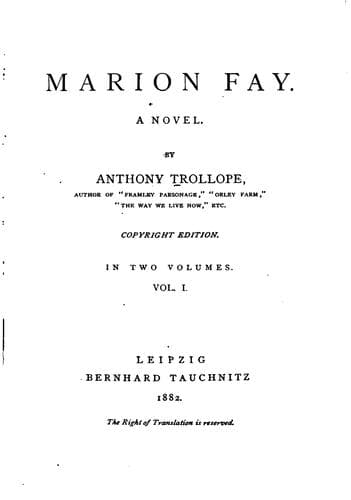
England -- Fiction; Love stories; Male friendship -- Fiction; Quakers -- Fiction; Social classes -- Fiction
I hold that nothing is so likely to be permanently prejudicial to
the interest of hunting in the British Isles as a certain flavour of
tip-top fashion which has gradually enveloped it. There is a pretence
of grandeur about that and, alas, about other sports also, which is,
to my thinking, destructive of all sport itself. Men will not shoot
unless game is made to appear before them in clouds. They will not
fish unless the rivers be exquisite. To row is nothing unless you can
be known as a national hero. Cricket requires appendages which are
troublesome and costly, and by which the minds of economical fathers
are astounded. To play a game of hockey in accordance with the times
you must have a specially trained pony and a gaudy dress. Racquets
have given place to tennis because tennis is costly. In all these
cases the fashion of the game is much more cherished than the game
itself. But in nothing is this feeling so predominant as in hunting.
For the management of a pack, as packs are managed now, a huntsman
needs must be a great man himself, and three mounted subordinates are
necessary, as at any rate for two of these servants a second horse
is required. A hunt is nothing in the world unless it goes out four
times a week at least. A run is nothing unless the pace be that of a
steeplechase. Whether there be or be not a fox before the hounds is
of little consequence to the great body of riders. A bold huntsman
who can make a dash across country from one covert to another, and
who can so train his hounds that they shall run as though game were
before them, is supposed to have provided good sport. If a fox can be
killed in covert afterwards so much the better for those who like to
talk of their doings. Though the hounds brought no fox with them, it
is of no matter. When a fox does run according to his nature he is
reviled as a useless brute, because he will not go straight across
country. But the worst of all is the attention given by men to things
altogether outside the sport. Their coats and waistcoats, their boots
and breeches, their little strings and pretty scarfs, their saddles
and bridles, their dandy knick-knacks, and, above all, their flasks,
are more to many men than aught else in the day's proceedings. I
have known girls who have thought that their first appearance in
the ball-room, when all was fresh, unstained, and perfect from the
milliner's hand, was the one moment of rapture for the evening. I
have sometimes felt the same of young sportsmen at a Leicestershire
or Northamptonshire meet. It is not that they will not ride when
the occasion comes. They are always ready enough to break their
bones. There is no greater mistake than to suppose that dandyism is
antagonistic to pluck. The fault is that men train themselves to care
for nothing that is not as costly as unlimited expenditure can make
it. Thus it comes about that the real love of sport is crushed under
a desire for fashion. A man will be almost ashamed to confess that
Public-domain text, read in full here on John Shaqi.
Reviews
Reviews
No reviews yet
Be the first to share your thoughts on this work.
Elsewhere in the archive
Join the Discussion
Join the discussion
Sign in to leave a comment or review.
Sign InorCreate an account