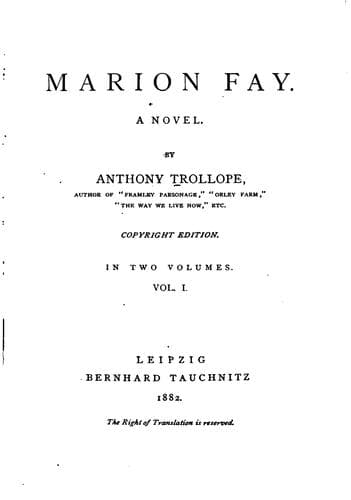
England -- Fiction; Love stories; Male friendship -- Fiction; Quakers -- Fiction; Social classes -- Fiction
own intimacy with a companion whose outside position in the world
had been inferior to his own, he had been proud of what he had done,
and had answered those who had remonstrated with him with a spirit
showing that he despised their practices quite as much as they
could ridicule his. He had explained to his father his own ideas of
friendship, and had been eager in showing that George Roden's company
was superior to most young men of his own position. There had been
Hautboy, and Scatterdash, and Lord Plunge, and the young Earl of
Longoolds, all of them elder sons, whom he described as young men
without a serious thought in their heads. What was it to him how
Roden got his bread, so long as he got it honestly? "The man's
the man for a' that." Thus he had defended himself and been quite
conscious that he was right. When Roden had suddenly fallen in love
with his sister, and his sister had as suddenly fallen in love with
Roden,--then he had begun to doubt. A thing which was in itself
meritorious might become dangerous and objectionable by reason of
other things which it would bring in its train. He felt for a time
that associations which were good for himself might not be so good
for his sister. There seemed to be a sanctity about her rank which
did not attach to his own. He had thought that the Post Office clerk
was as good as himself; but he could not assure himself that he was
as good as the ladies of his family. Then he had begun to reason with
himself on this subject, as he did on all. What was there different
in a girl's nature that ought to make her fastidious as to society
which he felt to be good enough for himself? In entertaining the
feeling which had been strong within him as to that feminine
sanctity, was he not giving way to one of those empty prejudices of
the world, in opposition to which he had resolved to make a life-long
fight? So he had reasoned with himself; but his reason, though it
affected his conduct, did not reach his taste. It irked him to think
there should be this marriage, though he was strong in his resolution
to uphold his sister,--and, if necessary, to defend her. He had not
given way as to the marriage. It had been settled between himself
and his sister and his father that there should be no meeting of the
lovers at Hendon Hall. He did hope that the engagement might die
away, though he was determined to cling to her even though she clung
to her lover. This was his state of mind, when this hideous young
man, who seemed to have been created with the object of showing
him how low a creature a Post Office clerk could be, came across
him, and almost convinced him that that other Post Office clerk had
been boasting among his official associates of the favours of the
high-born lady who had unfortunately become attached to him! He would
stick to his politics, to his Radical theories, to his old ideas
about social matters generally; but he was almost tempted to declare
Public-domain text, read in full here on John Shaqi.
Reviews
Reviews
No reviews yet
Be the first to share your thoughts on this work.
Elsewhere in the archive
Join the Discussion
Join the discussion
Sign in to leave a comment or review.
Sign InorCreate an account