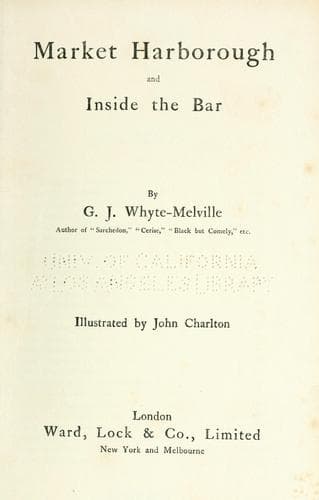
Market Harborough, and Inside the BarWhyte-Melville, G. J. (George John)
General
Market Harborough, and Inside the Bar
Whyte-Melville, G. J. (George John)
Country life -- England -- Fiction; English fiction -- 19th century; Fox hunting -- Fiction
He found the senior busy in his little saddle-room, engaged in no less
important an occupation than the improvement of The Boy’s morals and
general deportment, for which I grieve to observe, since his arrival at
Harborough, there was sufficient room. The youth, though he worked hard,
was seldom sober now, and never told the truth but by accident. Isaac’s
method of imparting ethical instruction was uncompromising, if not
agreeable. With the lad’s collar in one hand, and a spare
stirrup-leather in the other, he insisted forcibly on those maxims which
he considered most salutary to the tender mind, accompanying each with a
stinging illustration from the strap; the dialogue between the sage and
his disciple being conducted much in this wise:—
Isaac: “I’ve told you over and over again, ye young warmint, and I’ll
tell it ye every day I live, if I larrup the skin off ye.” (Whack.)
The Boy: “Oh, please!”
Isaac: “You’ll never rise in life, nor be fit to be called a stableman,
without you can work them qualities which have made _me_ what I am;
that’s what I am a teaching of ye.” (Whack.)
The Boy: “Oh, please!”
Isaac: “First and foremost, sobriety.”—(Whack, and “Oh, please!”)
“Secondly, honesty, coupled with early rising.”—(Whack again, and a
howling “Oh, please!” from the pupil.) “Thirdly and lastly,
sobriety.”—(Whack.) “I’ll go over ’em again; them’s the three cardinal
virtues. You mind what I’m a tellin’ ye—Sobriety, honesty, coupled with
early rising, and sobriety.” (Whack, whack, whack; and “Oh, please! oh,
please! oh, please!”)
At this juncture, Mr. Tiptop entered. Casting an approving glance at the
mode of treatment adopted, he seated himself on an inverted
stable-bucket, and professed his readiness to await old Isaac’s leisure
ere he asked to have “a word with him.” The other let go of The Boy’s
collar—who darted from the place like a weasel—and put on his own coat
and hat. Thus armed, he waited to hear what his guest had to say. Mr.
Tiptop broached the subject at once.
“Rum go, this here!” said he, hoisting his hat on to his eyebrows.
“Uncommon queer start it is, about your bay horse. Can’t get him _out_,
I can’t, do what I will with him; the beggar seems well, too, and pretty
fit, as far as I see, and I’ve trained a few of them! If I didn’t _know_
he was a smartish nag now, I should say he was as slow as an eight-day
clock when it runs down. What am I to think of it?”
Isaac’s little blue eyes twinkled for an instant, but turned to stone
once more, as he replied slowly, “Think of it? Well, it seems to _me_,
now, that he won’t be much use to your governor if he can’t win.”
“Not he!” answered Mr. Tiptop, contemptuously. “I could have told _you_
that. What I want to know is, why the beggar was so much better in your
stable than in ours? Come, old chap! you and me has always been good
friends, give us an _item_ now; what would you do with him, if you was
me?”
Public-domain text, read in full here on John Shaqi.
Market Harborough, and Inside the Bar — John Shaqi
Reviews
Reviews
No reviews yet
Be the first to share your thoughts on this work.
Elsewhere in the archive
Join the Discussion
Join the discussion
Sign in to leave a comment or review.
Sign InorCreate an account