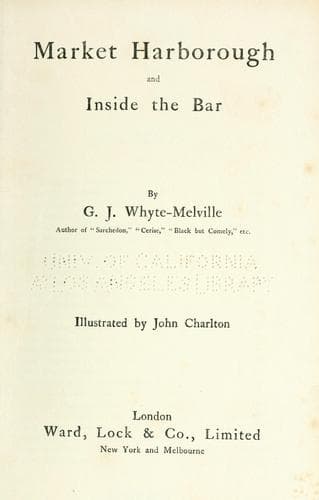
Market Harborough, and Inside the BarWhyte-Melville, G. J. (George John)
General
Market Harborough, and Inside the Bar
Whyte-Melville, G. J. (George John)
Country life -- England -- Fiction; English fiction -- 19th century; Fox hunting -- Fiction
His companion—no other than the redoubtable chestnut which Crasher had
been riding to covert on his first introduction to our friend—would have
been rated as an experienced break-horse by few persons less reckless
than his master. He was what is called “a bad starter,” but made up for
that deficiency by being as difficult to stop, when once off, as he was
at first to set in motion. He had a way, too, of hugging the pole when
out of humour, most subversive of his companion’s equanimity. Such
tricks were, doubtless, against the progress of Marathon’s education.
Altogether a more unpleasant pair, for locomotive purposes, have seldom
been “lapped in leather.”
There is no proverb more true than that “Where there is no fear, there
is no danger.” The Honourable Crasher’s nerves seemed not only totally
unsusceptible to the unworthy sensation
“Which schoolboys denominate ‘funk,’”
but he appeared utterly to ignore the possibility of anything like a
casualty wherever horseflesh was concerned. The consequence was that,
both in the saddle and on the coach-box, he came scathless out of
scrapes that must have been fatal to a man of a more nervous
temperament.
I will not dwell on the drive from Market Harborough to the Dove-cote—on
the tension of Mr. Sawyer’s nerves, and corresponding rigidity of his
muscles, whenever the wheel grazed a heap of stones or an ominous bang
against the splash-board reminded him that Marathon had not forgotten
how to kick. The Boy, indeed—selected for the office as being of light
weight—spent most of the journey on the hind-step, prepared for the
worst, but was not obliged to get down and run to their heads more than
a dozen times in the course of as many minutes, after which they settled
to their work and pulled like griffins. It is sufficient to say that,
when they arrived at the Rectory door, close on the tracks of the
ignominious fly that had preceded them at least half an hour, Mr.
Sawyer’s white tie was uncrumpled, and the Honourable’s whiskers still
in tolerable curl.
There was but one stranger present. The Reverend knew how to give a
dinner, or if _he_ didn’t his wife did, and had too much consideration
for his Harborough friends to inundate them with a host of country
neighbours with whom they were not acquainted. This exception was a
widowed cousin of Mrs. Dove’s—a voluble lady, not so young as she had
been, wearing her shoulders very bare, her dress very full, and her fair
hair puffed out with considerable ingenuity. She was a little rouged, a
little made-up, but very good-looking notwithstanding, in a _blonde_,
full-blown, boisterous style. A better foil for “Cissy” could scarcely
be imagined. This buxom beauty answered to the name of Merrywether, and,
to all appearance, would have had no objection to change it.
Public-domain text, read in full here on John Shaqi.
Reviews
Reviews
No reviews yet
Be the first to share your thoughts on this work.
Elsewhere in the archive
Join the Discussion
Join the discussion
Sign in to leave a comment or review.
Sign InorCreate an account