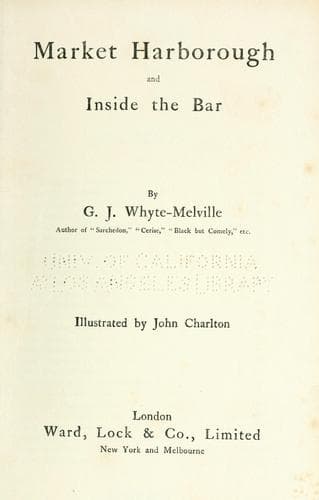
Market Harborough, and Inside the BarWhyte-Melville, G. J. (George John)
General
Market Harborough, and Inside the Bar
Whyte-Melville, G. J. (George John)
Country life -- England -- Fiction; English fiction -- 19th century; Fox hunting -- Fiction
Their course lay along one of those field-roads so common in
Leicestershire, where the track on a dark night is not easily
distinguished from the adjacent ridge-and-furrow, and which, delightful
to the equestrian for that very reason, as no jealous fence prevents him
diverging for a canter on to the springy pasture, are less convenient
for carriages owing to the number of gates that delay the passage of the
vehicle. They were now approaching the first of these obstacles to their
course, and Crasher had not yet got a pull at his horses.
“It’s open, I think,” remarked the Honourable, peering into the darkness
ahead, and endeavouring to moderate the pace without effect.
“I think _not_!” replied Mr. Sawyer, setting his teeth for a
catastrophe.
Right again! Three more strides and they were into it!
A crackling smashing noise of broken wood-work—one or two violent bangs
against the splash-board—a faint expostulation of “_Gently_, my lads!”
from the Honourable—a tremendous jolt against the post, which was torn
up by the roots—and Mr. Sawyer found himself on his face and hands in an
exceedingly wet furrow; a little stunned, a good deal confused, and
feeling very much as if somebody had knocked him down, and he did not
know whom to be angry with.
As he rose and shook himself to ascertain that no bones were broken,
much struggling and groaning as of an animal in distress, mingled with
weeping and lamentation from a human voice, smote on his ear. The former
arose from Marathon, who couldn’t get up, with the other horse and the
pole and part of the carriage atop of him: the latter from The Boy, who,
frightened for the moment into a spurious sobriety, thus gave vent to
his feelings of utter despondency and desolation.
“I thought the brute _could_ jump timber,” said a calm voice in the
surrounding darkness. “Let us see: _here’s_ the carriage—_there_ are the
horses—and _that_ must be The Boy. Where are _you_, Sawyer?”
“Here!” answered our friend, coming forward, rubbing his elbows and
knees, to discover if he was hurt; the Honourable, who had never
abandoned his cigar, endeavouring to extricate the horses—a measure only
to be accomplished by dint of cutting the harness—and to estimate the
amount of damage, and the impossibility of putting in to refit.
Our friend set to work with a will. By their joint endeavours they
succeeded at last in getting the hapless Marathon and his companion
clear of the wreck. Both were obviously lamed and injured; the carriage,
as far as could be made out in the darkness, broken all to pieces.
The Boy, after flickering up for a few minutes, had become again
unconscious. As the old watchman used to sing out, it was “Past one
o’clock and a stormy morning!”
“Whereabouts are we?” asked Mr. Sawyer in dolorous accents, as he tried
to persuade himself he ought to be thankful it was no worse.
“Whereabouts are we, and what had we better do?”
Public-domain text, read in full here on John Shaqi.
Reviews
Reviews
No reviews yet
Be the first to share your thoughts on this work.
Elsewhere in the archive
Join the Discussion
Join the discussion
Sign in to leave a comment or review.
Sign InorCreate an account