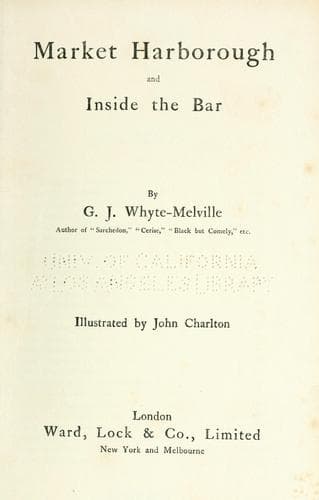
Market Harborough, and Inside the BarWhyte-Melville, G. J. (George John)
General
Market Harborough, and Inside the Bar
Whyte-Melville, G. J. (George John)
Country life -- England -- Fiction; English fiction -- 19th century; Fox hunting -- Fiction
ABOUT this period there might have been—and indeed, by his intimates,
there _was_—remarked an obvious change in the appearance, habits, and
general demeanour of our friend. No longer dressed in the
rough-and-ready style which had heretofore been at once his glory and
his peculiarity, Mr. Sawyer now began to affect a strange refinement of
costume, bordering on effeminacy. His boots were thinner and much
tighter than of old; he turned his collars over his neckcloth, after the
prevailing fashion, thereby imparting to his physiognomy an expression
of romantic vacuity; anointed his head till it shone again; affected
gloves on all occasions, and set up a ring. Altogether, his exterior was
as symptomatic of his disorder as that of Benedict. Also he purchased,
at a printseller’s over the way, a representation of a young person
washing her feet in a stream, and purporting to be a “Highland Lassie,”
but of a meretricious aspect which, it is only fair to state, is rarely
to be observed amongst the Scottish mountaineers. It was one of those
startling accidental likenesses to the lady of his affections, which a
man must be as hard hit as Mr. Sawyer to detect. In the hunting-field,
too, he adopted an ambitious style of riding, totally at variance with
his previous quiet, straightforward form; and a considerable interval of
bad-scenting weather enabled him to distinguish himself to his heart’s
content. When hounds run best pace, horses have not wind for
extraordinary exertions in the matter of fencing; and, moreover, such
saltatory exploits as are out of the common way can be witnessed but by
few, and those are completely engrossed in their own doings; but when
the pack checks in every field, a man who chooses to single himself out
by charging the ugliest bullfinches and the stiffest rails, either
because he wants to attract attention or to sell his horse, has every
opportunity of showing up the latter and calling down upon himself the
animadversions of all true sportsmen. Our friend, with the two horses he
bought from Mr. Varnish—both capital leapers—in addition to Hotspur and
the grey, had no lack of material on which to flourish away in too close
proximity to the chase. Charles Payne, though with a strong
fellow-feeling for “keenness,” began to hate the sight of him, Mr.
Tailby to dread his appearance as he would that of a black frost, and
Lord Stamford to find that even _his_ imperturbable good-humour might be
exhausted at last.
What is to be expected, however, of a gentleman who has taken to
repeating Montrose’s well-known lines—
“If doughty deeds my lady please,
Right soon I’ll mount my steed;
And keen his lance, and strong his arm,
That bears from me the meed;”
varied by the resolute sentiment—
Public-domain text, read in full here on John Shaqi.
Reviews
Reviews
No reviews yet
Be the first to share your thoughts on this work.
Elsewhere in the archive
Join the Discussion
Join the discussion
Sign in to leave a comment or review.
Sign InorCreate an account