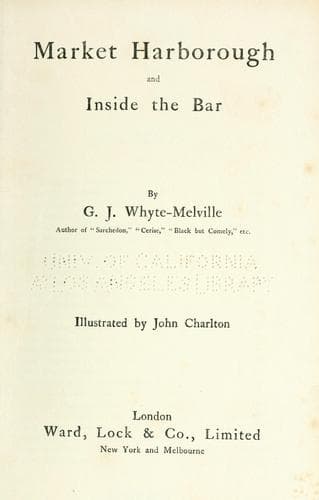
Market Harborough, and Inside the BarWhyte-Melville, G. J. (George John)
General
Market Harborough, and Inside the Bar
Whyte-Melville, G. J. (George John)
Country life -- England -- Fiction; English fiction -- 19th century; Fox hunting -- Fiction
Crippled as I was, I may here remark, once for all, that I was solely
dependent for amusement on the perusal of such characters as I met in
the bar at the Haycock. Deprived of my hunting, not overfond of reading,
here was a book laid open, so to speak, before me, of which I had not
even the trouble to turn the page, whilst the peculiarities of these
different visitors furnished an inexhaustible fund of amusement; their
rapid succession preserved me from the dangers of prolonged
_têtes-à-têtes_ with Miss Lushington—interviews that could but have
resulted in my total subjection by that seductive being, herself cold
and unimpressionable as marble, experienced in the falsehood of our sex,
and superior to the weaknesses of her own.
Off his horse, Tips was, to say the least, a very singular-looking
person. He was a low, strong, broad-shouldered man, a perfect Hercules
down to his waist, and with a length of arm and depth of chest that
would have made him an ugly customer in the ring, an appellation to
which his physiognomy also fully entitled him. Not that he had what is
termed a “fighting nob;”—far from it. High features, bushy eyebrows, an
aquiline nose, and a long, prominent chin gave him a sort of resemblance
to a dilapidated Henri Quatre; but the nose had been smashed and
thickened by a fall, the chin knocked on one side by the kick of a
horse, and one of the eyes, rent and lacerated by a thorn, was
disfigured by a ghastly droop of the lid, and a perpetual crimson in
what ought to have been the white of the eye; very large, thick
whiskers, of a rusty brown, framed this singular face, and a knowing,
wide-awake leer in the undamaged eye, would have told an observer,
without the aid of the blue-spotted neckerchief, that its proprietor was
a “party concerned about horses.” Nevertheless, the man had a game, bold
look about him, all the same,—that latent energy in his glance, which
denotes physical courage, and without which a good judge of his species
does not care to select one of the half-score he requires for the
manning of a life-boat, the capturing of a gun, or the performance of
any other dare-devil feat, that demands more boldness than brains. Had
Tips been moulded in fair proportions, he would have been a
heavy-weight; but below the waist, I must acknowledge, his limbs were
more like those of a monkey than a man. His stomach seemed all to have
gone up into his chest; and although his thighs were long, his thin
shrivelled legs were absurdly short and small below the knee. He was
made for a horseman and nothing else; nor, when you saw him at daybreak,
exercising some lawless three-year-old, with its mouth full of “keys”
and its dogged, sullen eye, prepared to take the slightest advantage of
its rider, either to jump, kick, rear, or go backwards, could you help
acknowledging that here, at least, was the _right_ man in the _right_
place. Of his early history I gathered some particulars from himself. I
Public-domain text, read in full here on John Shaqi.
Reviews
Reviews
No reviews yet
Be the first to share your thoughts on this work.
Elsewhere in the archive
Join the Discussion
Join the discussion
Sign in to leave a comment or review.
Sign InorCreate an account