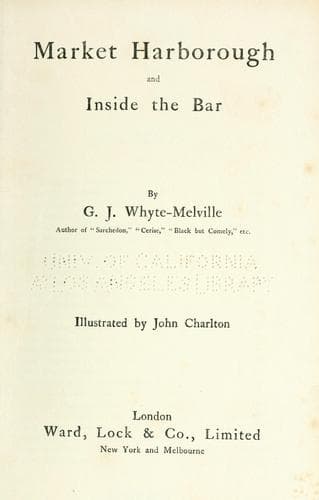
Market Harborough, and Inside the BarWhyte-Melville, G. J. (George John)
General
Market Harborough, and Inside the Bar
Whyte-Melville, G. J. (George John)
Country life -- England -- Fiction; English fiction -- 19th century; Fox hunting -- Fiction
“No, sir, I don’t,” was the reply; “vice in a horse is the most
troublesome fault of all to cure, because it’s always breaking out
again, and because a vicious beast is sure to be a sensible beast too.
The horse-riders, you know, sir—them as teaches horses to fire pistols,
and make tea, and dance on the tight-rope, and what not—they always give
the preference to what they call a _restive_ one, because you see it’s
the beast’s sagacity that makes him so difficult to break, if so be the
breaker has begun with him the wrong way. It’s all _humbug_, sir, is
horsemanship, that’s what it is; and the easier a horse is humbugged,
the pleasanter he is to ride and drive. Now a real knowing ’un won’t be
humbugged at no price, and so we come to forcing of him, which is always
a difficult business, and then it’s ‘pull devil, pull baker,’ and if the
baker pulls hardest, why we call him vicious. But he’s always got his
wits about him, he has. He may be aggravating, _very_: but you can’t
call him _dangerous_. He won’t put _himself_ into a mess, not if he
knows it, and so he’s bound to take care of _you_, so long as you don’t
part company. I recollect of a nag, a very neat one, as belonged to a
friend of mine, who says to me one evening, ‘Tips,’ says he, ‘I’ll sell
you my bay Galloway,’ says he, ‘for seventeen sovereigns, there, and a
glass of gin-hot, for I dursn’t ride him, and that’s the truth.’ ‘I’ll
give you three five-pun’ notes and a bottle of French brandy,’ says I,
‘if it’s all on the square.’ ‘Done!’ says he. ‘Done!’ says I; ‘and now
what’s his little game?’ says I, when I’d ordered the brandy. ‘Well,’
says my friend, ‘whenever I ride down wharf-side to my business, he
makes a dash for the canal, and tries to plunge over head in the deep
water.’ ‘Has he ever been _in_ with you?’ says I. ‘Never!’ said he, ‘and
I’ll take care he never _shall_. I’m a family man, Mr. Tips, and plagued
with the rheumatics besides.’”
“So I brought the little nag home: and next day I took a sharp pair of
spurs, and an ash-plant, and rode him down wharf-side quite easy and
confidential. Sure enough he takes the bit in his mouth, and away he
goes best pace for the canal. We came at it so fast I thought we must
both have been in; and he stopped so short on the edge, if I hadn’t been
ready for him, I must have gone clean over his head. Well, he fought and
fought, but I couldn’t force him into it, till at last I got his hind
legs close to the brink, and I slipped off his back, and with a jerk of
the bridle, tipped him over as neat as wax. He had to swim for a hundred
yards and more alongside the towing-path afore he could get out, and he
never tried on _that_ game agin, you may take your oath. He was a sweet
cob as ever you see to carry fourteen stone, and I sold him to an old
gentleman at Croydon for five-and-forty sovereigns, money down. But he
didn’t want to go into the canal, bless ye; though once he _was_ in, he
swam like an otter.”
Public-domain text, read in full here on John Shaqi.
Reviews
Reviews
No reviews yet
Be the first to share your thoughts on this work.
Elsewhere in the archive
Join the Discussion
Join the discussion
Sign in to leave a comment or review.
Sign InorCreate an account