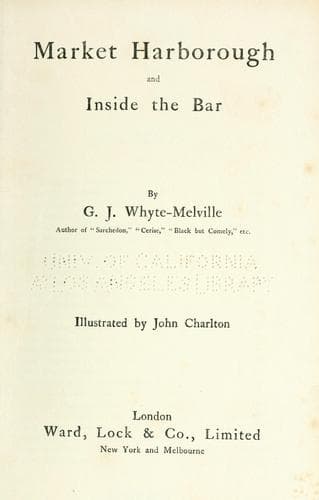
Market Harborough, and Inside the BarWhyte-Melville, G. J. (George John)
General
Market Harborough, and Inside the Bar
Whyte-Melville, G. J. (George John)
Country life -- England -- Fiction; English fiction -- 19th century; Fox hunting -- Fiction
When young Naggett’s education was supposed to be completed, and he came
home to live with his father as a lad of sixteen, there was not probably
a more finished young blackguard to be found within a circle of fifty
miles. The old man tried hard to make him work, but it was hopeless;
whilst at races, fairs, village feasts, anything in the shape of a
junketing, he was safe to attend and safe to get into mischief. Then he
always kept two or three greyhounds, much to the disgust of the Earl of
Castle-Cropper, his father’s landlord; and though he generally had a
pretty good nag of the old man’s to ride when he chose, he never won the
Earl’s respect by any display of daring in the field. Young Naggett’s
heart was not in the right place to ride well over a country, and
although he liked the excitement and display of hunting, it was not for
the sake of the sport that he attended at the covert-side.
His father died the year his son came of age, and the just old Earl,
though much against the grain, on his usual principle let the latter
continue the farm. Then began a career of extravagance that necessarily
ran itself out in a brief space of time. Late breakfasts, silver forks,
six-o’clock dinners, port, sherry, and punch till all the hours of the
night, with three or four riding-horses in the stable, and a box of
cigars always open in the hall, made Apple-tree Farm the most popular
resort in the neighbourhood for every “good-for-nothing” in the
country-side. This style of living went on for eighteen months. Then
came a bad harvest, the failure of a county bank, and a sale at the
farm, with Richard Naggett’s name amongst the list of bankrupts, and a
loss to the Earl of Castle-Cropper of more than he cared to think about.
Nevertheless, his old landlord never quite turned his back on his
tenant, and therefore we may fairly suppose that, beyond reckless
imprudence, there was nothing tangible against the latter, and that in
the main, and when confronted with a Waterborough lawyer, he acted what
is called “on the square.”
After this crisis, young Naggett was not much heard of, for some time.
There _was_ indeed an ugly poaching story in which the Earl was supposed
to have dealt very leniently with the offender in consideration of
certain old associations, and which, if possible, increased that
nobleman’s popularity, to the detriment of the culprit he had screened;
and there was likewise a very disagreeable show-up on Waterborough
race-course in regard to a horse called Cat’s Cradle, who was entered,
weighted, and described wrong for the Tally-ho Stakes, and then most
indubitably pulled by young Naggett, riding as a tenant-farmer, without
occupying one foot of land. There is a horse-pond at the end of the
course, and it was only the good-nature of some of the townspeople, and
the excitement created at the same moment by the detection of a
_maladroit_ pickpocket, that saved the adventurous jockey from
involuntary immersion therein.
Public-domain text, read in full here on John Shaqi.
Reviews
Reviews
No reviews yet
Be the first to share your thoughts on this work.
Elsewhere in the archive
Join the Discussion
Join the discussion
Sign in to leave a comment or review.
Sign InorCreate an account