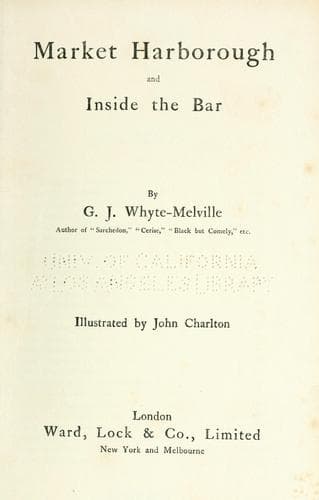
Market Harborough, and Inside the BarWhyte-Melville, G. J. (George John)
General
Market Harborough, and Inside the Bar
Whyte-Melville, G. J. (George John)
Country life -- England -- Fiction; English fiction -- 19th century; Fox hunting -- Fiction
It was not in my nature to fraternise very cordially with a gentleman of
Mr. Naggett’s superior qualities. I am bound, nevertheless, to admit,
that his advances towards myself were cordial, not to say familiar in
the extreme. The undisguised admiration, however, with which Miss
Lushington regarded his every movement, and the terms of intimacy on
which he obviously stood with that decorous lady, may have prejudiced me
somewhat against him. There is a class of men, however, I have often
observed, and I say it in justice to Miss Lushington, with whom the
genus Barmaid seems to possess some mysterious affinity. As Eastern
poets feign that there is a certain bird to which the tree involuntarily
bends its branches, and the flower opens its petals, so I am convinced
there is a description of individual who is looked on with peculiar
favour by actresses, barmaids, hostesses, and other ladies whose
avocations bring them much into the presence of a discerning public.
These favourites of her sex are generally remarkable for exuberance of
spirits, command of language, a vivid freshness of complexion, and
general freedom of manner. They are loud in assumption, and great on all
topics of political or public interest; also prone to plunge into
quarrels, from which they invariably extricate themselves without
recourse to ulterior measures. His female admirers, in describing such a
one, generally sum up their catalogue of his merits by vowing that he is
“very free in company, and _quite the gentleman_.”
Mr. Naggett, stirring the fire with his boot, and winking facetiously on
Miss Lushington, as he drank her health in his hot negus, and asked her
whether she had ordered her wedding-bonnet yet, obligingly remarked,
that “it was a cold night, and he was sorry to see my arm in a sling;”
also “that he had heard of my accident, and hoped it wouldn’t be long
before I _over-got_ it,” with which friendly wish, expressed in a
compound verb, he finished his negus, and ordered some more, calling
Miss L. “my dear,” unblushingly, to my excessive disgust. He then drew
his chair to the fire, expressed his astonishment that Tips had gone to
“perch,” as he called it, and proceeded to make himself agreeable.
“A nasty fall, sir, yours must have been, as I understand,” said he,
“and it’s well as it wasn’t worse. You’ve a nice-ish team standing here,
but you’ll excuse _me_, sir, they’re not exactly the _class_ of horse
for a gentleman like you to ride. I’ve been fond of horses all my life,
from a boy, I may say, and I’m forty years of age now: forty years of
age, though perhaps you wouldn’t think it, and in that time I’ve learned
to keep my eyes open. Now, sir, you don’t ride so very light, I’ll be
bound to say.”
Public-domain text, read in full here on John Shaqi.
Reviews
Reviews
No reviews yet
Be the first to share your thoughts on this work.
Elsewhere in the archive
Join the Discussion
Join the discussion
Sign in to leave a comment or review.
Sign InorCreate an account