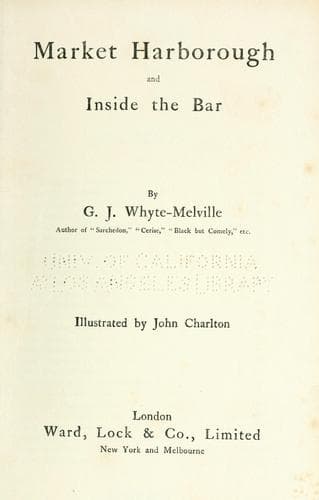
Market Harborough, and Inside the BarWhyte-Melville, G. J. (George John)
General
Market Harborough, and Inside the Bar
Whyte-Melville, G. J. (George John)
Country life -- England -- Fiction; English fiction -- 19th century; Fox hunting -- Fiction
In this one respect Tom Turnbull resembles Dick Turpin; the former, too,
has a mare he rides long journeys by night, and for whose merits and
reputation he entertains the profoundest respect. She is a lengthy, low,
wiry, bay mare, with short flat legs, clean and hard as iron. She
rejoices in a lean, game head, with a curl not unlike a sneer above her
nostrils, and a wild eye; also, the long, fine, and rather lop ears,
which belong to her high-born family. In the breeding of all stock Mr.
Turnbull knows what he is about. If he wants a promising foal that shall
grow into a couple of hundred pounds at five years old, he does not put
an old worn-out mare, whose constitution and physical qualities are
exhausted by hard work, to a fashionable stallion, and calmly expect the
produce to excel the united excellencies of sire and dam in the best
days of both. On the contrary, he begins, as we humbly opine, at the
right end. He gets a foal or two out of the young fresh mare before she
commences work, instead of after she is incapable of it. The dam’s
functions are then in their highest state of vigour and redundance; nor
is it possible but that this must materially enhance the value of her
offspring. The infant is all the better, and the mother none the worse.
The Arabs, who are by no means behindhand in their knowledge of horses,
and whose everyday wants necessitate their bringing the animal to its
highest state of perfection, at least as regards their own purposes,
have established, as an incontestable maxim, that while the colt
inherits “make and shape” from his sire, his inner qualities—if we may
so call them—his mettle, speed, temper, and powers of endurance come
from his dam. None of us who have taken an interest in the rearing of
young horses can have failed to observe the strong outward resemblance
they usually bear to their sires. “How like the old horse!” is a remark
one hears every day when looking at some dark-brown flyer by The
Dutchman, or some commanding animal with extraordinary power and
substance by Cotherstone; but we seldom see any striking resemblance to
the dam, although, when some veteran sportsman is relating the feats of
the “best he ever had in his life,” whether hunter, hack, or trotter, he
generally winds up with the observation, “He was as good as the old
mare!” Now, the Arab ought to be a capital judge, and though by no means
despising speed, endurance is the quality which he most values in his
horse, and puts most frequently to the test. It is no unusual feat for
an Arab to ride a hundred miles a day for four days together, through
the desert, carrying with him (no trifling addition to his own weight)
the water that is to last him throughout his journeys, also the forage
that must supply his steed, and the handful or two of pressed dates that
shall serve to keep the rider alive till he reaches his destination. Now
we have nothing of this sort in England, and, since the introduction of
Public-domain text, read in full here on John Shaqi.
Reviews
Reviews
No reviews yet
Be the first to share your thoughts on this work.
Elsewhere in the archive
Join the Discussion
Join the discussion
Sign in to leave a comment or review.
Sign InorCreate an account