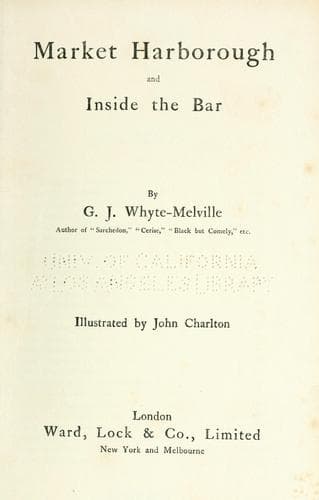
Market Harborough, and Inside the BarWhyte-Melville, G. J. (George John)
General
Market Harborough, and Inside the Bar
Whyte-Melville, G. J. (George John)
Country life -- England -- Fiction; English fiction -- 19th century; Fox hunting -- Fiction
He is a tough, spare old man, very lean and very wrinkled, who looks as
if all the juices had been exuded from his body by severe and
unremitting exercise, till nothing has been left but sinew, gristle, and
a pair of keen, dark eyes, like those of a hawk. It is as if the
original Isaac had been boiled down to what chemists call a _residuum_,
and “Ike” was the result. He must have been a tall fellow in his youth,
although he is now so bent, and twisted, and knotted, that he carries
his head at a much lower elevation than was intended by Nature, and his
light, wiry form still denotes the possession of considerable strength.
To look at him, you could swear he was the sort of fellow who was the
best runner, leaper, cricketer, and fisherman of his parish; who could
throw a stone further, and consequently hit harder, than any of his
brother-yokels, and who was sure to be at the core of all the
merry-making, and half the mischief that angered the squire and made the
parson grieve. There is always one such scapegrace in every hamlet. As a
boy at the village school, he climbs the tallest elms, takes the
earliest birds’ nests, and is constantly prowling about the belfry, to
curry favour with the ringers, and interfere, with unspeakable interest,
when anything is done to the church clock. As a lad, he turns out a
swift bowler, a dead hand at skittles, and a very useful fellow at all
odd jobs; yet somehow, continually out of work. By degrees, he becomes
an irregular attendant at church, and is always hankering about the
stream, partly to make love to the miller’s daughter, and partly (as the
squire’s keeper—a wary old bird, who began in exactly the same way
himself—has found out) to set night-lines, trimmers, and such
abominations, thereby entering unfailingly on the downward career of the
poacher, to which “the contemplative man’s recreation” is apt to be the
first step. After that, he gets thoroughly inoculated with the fatal
passion. Then come the “shiny nights,” the slaughtered pheasants, and
the netted hares; the sleep by day; the pot-house rendezvous; the
covered cart driven to a poulterer’s, who ought to know better, in the
neighbouring market-town; the general laxity of principle, and utter
demoralisation consequent on a life of habitual crime—perhaps the
irresistible temptation of too heavy a sweep, the conflict with the
keepers, fought out fiercely and unsparingly on both sides, to result in
a verdict of manslaughter, and transportation for life.
Public-domain text, read in full here on John Shaqi.
Reviews
Reviews
No reviews yet
Be the first to share your thoughts on this work.
Elsewhere in the archive
Join the Discussion
Join the discussion
Sign in to leave a comment or review.
Sign InorCreate an account