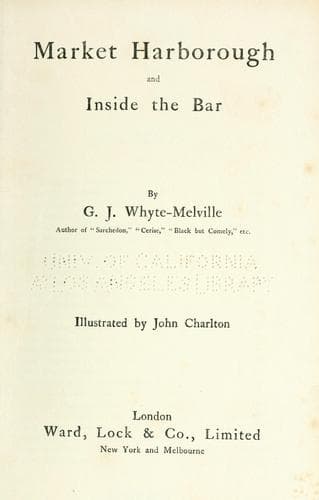
Market Harborough, and Inside the BarWhyte-Melville, G. J. (George John)
General
Market Harborough, and Inside the Bar
Whyte-Melville, G. J. (George John)
Country life -- England -- Fiction; English fiction -- 19th century; Fox hunting -- Fiction
Without being a deep student in natural history, I have not failed to
observe, that when a cow begins to put her muzzle to the ground, and
throw the earth about with her feet, she is prepared to toss and gore.
Also, that when a woman cocks her nose in the air, giving at the same
time an occasional sniff through that elevated organ, while a
perceptible rise and fall heaves the snowy cambric that veils her bosom,
it is the forerunner of a breeze. In either case it is advisable to
change the locality as rapidly as is practicable, and without reference
to the ordinary forms of politeness.
Under these circumstances, I made my way forthwith into the stableyard,
and had scarcely weathered the pump which commands its entrance, ere I
came face to face with a very important-looking personage, whom I could
not call to mind as having ever before seen within the precincts of The
Haycock. There was no mistaking his profession, which was that of
stud-groom. Not one of your working servants, who strips to his shirt on
occasion, and straps like a helper; but a real swell groom, always in
review order, just as I saw him now, and rejoicing in the only costume
of the present century which has not varied the least in my
recollection. These men have all the same figure—plump, dapper, and
short-legged: clad in the same attire, to wit—a straight-brimmed hat,
rather high in the crown; a pepper-and-salt cut-away coat,
single-breasted, and of a length in the back only equalled by the
shortness of its skirts; a blue-spotted neckcloth, with a horse-shoe
pin; a waistcoat of the most extensive dimensions; drab breeches, with
gaiters to match; and the old-fashioned watch-ribbon with a key at the
end. Like the Phœnix, the race is immortal and unchangeable. It
possesses its own language, its own customs, its own traditions. As
Napoleon the First said of the Bourbons, it learns nothing, and forgets
nothing. It is reflective, sagacious, sober, and methodical; but on the
other hand, it is opiniate, obstinate, wilful, and deaf to the voice of
reason. You may leave one of the order, with perfect confidence, in
charge of twenty horses, and be sure that everything will go on like
clockwork, and that you will not be robbed of a shilling more than what
he considers the due perquisites of his office; but if you want to
arrange about your nags for yourself, to move them here and there, to
enjoy for a day the pleasure of doing what you like with your own, be
sure that you will reap only vexation and disappointment, confessing at
length, in the bitterness of your heart, that the most accomplished of
servants is but one degree removed from the most tyrannical of masters.
Public-domain text, read in full here on John Shaqi.
Reviews
Reviews
No reviews yet
Be the first to share your thoughts on this work.
Elsewhere in the archive
Join the Discussion
Join the discussion
Sign in to leave a comment or review.
Sign InorCreate an account