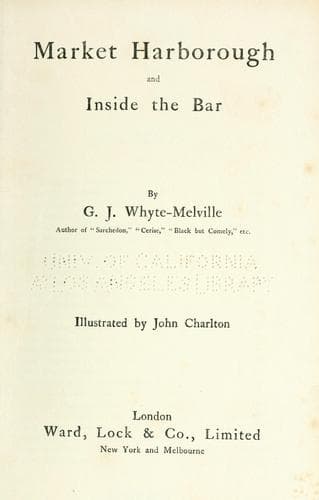
Market Harborough, and Inside the BarWhyte-Melville, G. J. (George John)
General
Market Harborough, and Inside the Bar
Whyte-Melville, G. J. (George John)
Country life -- England -- Fiction; English fiction -- 19th century; Fox hunting -- Fiction
This was the end of the argument, and I arrived at it precisely as I
reached a turn of the staircase that led to my bedroom. Justine was at
this instant coming down with a basket in her arms far too wide for the
narrow landing: the corner was exceedingly dark and inconvenient. In
common humanity I could not but stop to assist her. Not very
self-possessed at the best of times, I am afraid my efforts were of the
clumsiest. Between us, we got the basket in the angle of the two walls.
I was inside of it, and could not possibly get out: Justine could not
very well leave me imprisoned. She laughed a good deal, and blushed and
pulled as hard as she could. I, too, pushed vigorously, but it struck me
Justine was remarkably pretty, and that of all places in the world this
was the most whimsical for a conversation with a strange young woman of
lively manners and prepossessing exterior.
------------------------------------------------------------------------
CHAPTER VII
MISS MERLIN
AT length, by our joint efforts, the basket was extricated and placed
upon its—what shall I say?—on its right end, in the landing. The pretty
maid smoothed her hair and adjusted her collar, somewhat creased by her
exertions. I made an effort to recover the usual dignity of my
demeanour, conscious that I was, to a certain extent, in a false
position, yet resolved to make the best of it.
“Thank you,” said I, somewhat bashfully, as well as breathlessly.
“Thank _you_, sir,” said Justine; laughing, I thought, rather roguishly.
“Dear! how you’ve rumpled your collar,” I observed, with perfect
innocence. Justine glanced reproachfully in my face, as she smoothed the
collar down with a remarkably pretty hand, and, tilting the offending
basket on the bannisters, paused for a space, as if to “get her wind”
before proceeding any further. In a few minutes the process would be
accomplished, and Justine would take wing and fly away. I should never
have such an opportunity again—at least not for a considerable period.
The basket, in all probability, contained articles of wearing apparel,
either going to or coming from the wash. Without being a family man, I
was aware such an occurrence did not usually take place more than once a
week. I should have another seven days to wait before so favourable an
opportunity would arise again. Stimulated by this reflection I accosted
Justine with considerable energy. I am not sure that I did not take her
by the hand.
“Can I speak a word with you, mademoiselle?” said I, in trembling tones.
I do not know why I called her Mademoiselle, except that I was flurried
and eager, and inclined to be supremely polite.
“Not now, sir,” replied Justine, sinking her voice, to my great alarm,
incontinently to a whisper. “Some other time, Mr. Softly” (she had got
my name already): “not now, sir, _pray_. I hear somebody coming!”
Public-domain text, read in full here on John Shaqi.
Reviews
Reviews
No reviews yet
Be the first to share your thoughts on this work.
Elsewhere in the archive
Join the Discussion
Join the discussion
Sign in to leave a comment or review.
Sign InorCreate an account